

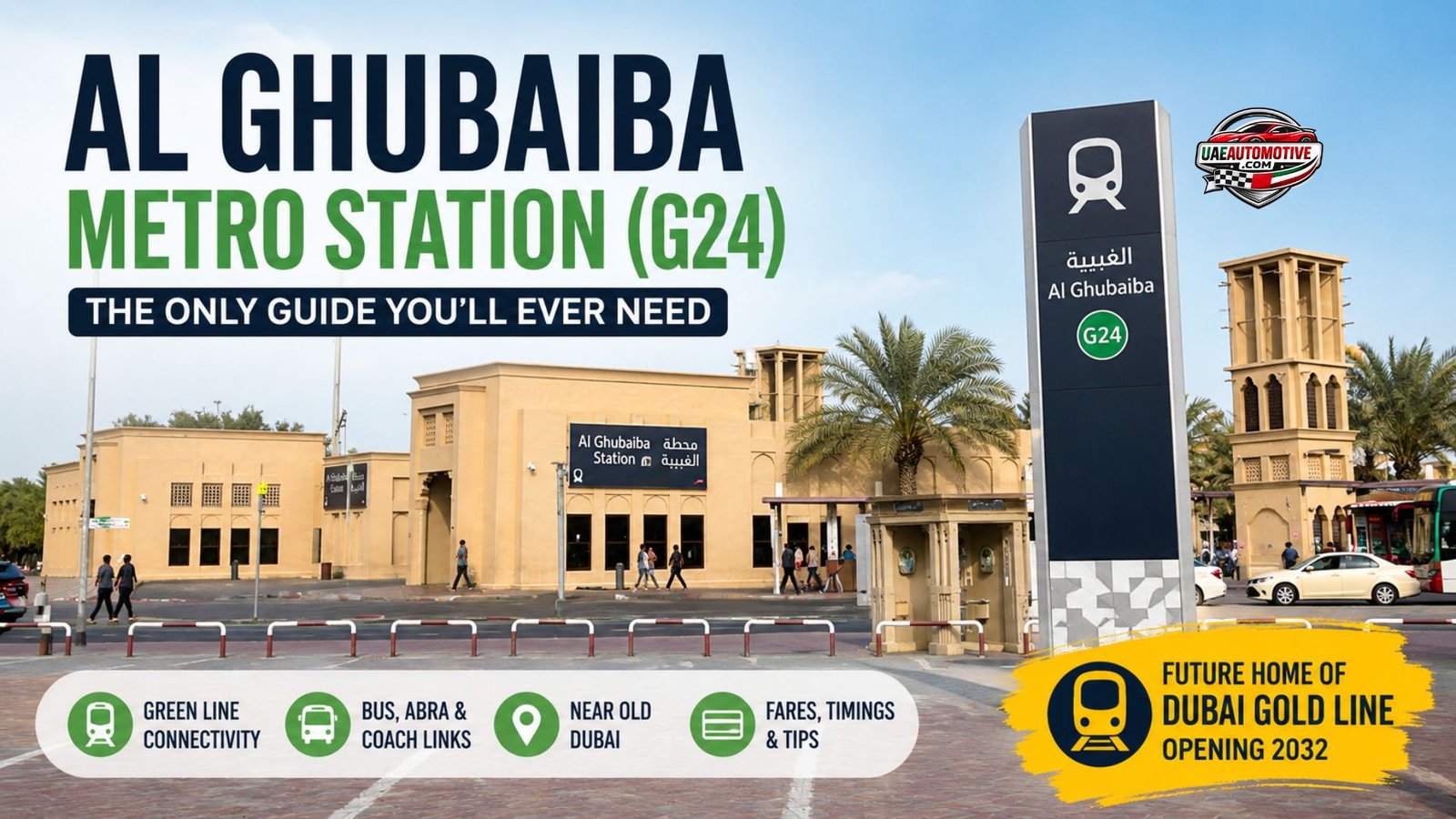
There’s a moment every first-time visitor to Dubai experiences: you step out of a metro station and suddenly the city doesn’t look like what you expected. No glass towers. No luxury mall. Just narrow streets, the smell of oud drifting from a shop doorway, wooden abra boats chugging across the water, and buildings that look like they belong in a different century entirely.
That moment happens at Al Ghubaiba Metro Station.
Coded G24 on the Green Line, this is one of Dubai’s most strategically positioned and culturally significant transit points. It serves around 20,000 passengers daily — a mix of daily commuters, intercity bus travelers arriving from Abu Dhabi and Sharjah, tourists exploring Old Dubai, and workers from the dense residential neighborhoods of Bur Dubai. But what makes it genuinely fascinating is that it’s also the starting point of Dubai’s brand-new AED 34 billion Gold Line metro, announced in April 2026 — something no other guide has talked about yet.
This article covers everything: timings, routes, fares, bus connections, what’s nearby on foot, insider tips competitors miss, and where this station is heading by 2032.
Have A Look On It: Stadium Metro Station 1 Dubai
- Quick Station Overview
- Where It Sits and Why That Matters
- Green Line Route from Al Ghubaiba
- Station Timings
- NOL Card Fares
- The Bus Station Connection: Al Ghubaiba's Real Superpower
- The Abra: One Dirham, Unmissable
- Station Design: The One That's Different
- What's Around Al Ghubaiba on Foot
- Food Near the Station: Where to Actually Eat
- Station Facilities
- Accessibility
- The Gold Line: Why Al Ghubaiba Just Got Much More Important
- Practical Tips That Most Guides Miss
- Common Mistakes to Avoid
- Frequently Asked Questions
Quick Station Overview
| Detail | Info |
| Full Name | Al Ghubaiba Metro Station |
| Station Code | G24 |
| Metro Line | Green Line |
| Station Type | Underground |
| District | Al Shindagha, Bur Dubai |
| Opened | 9 September 2011 |
| Daily Ridership | ~20,000 passengers |
| Fare Zone | Zone 6 |
| Adjacent Stations | Al Ras (G23) → Al Fahidi (G25) |
| Red Line Transfers | Union Station · BurJuman Station |
| Weekday Hours | Mon–Thu & Sat: 5:00 AM – 12:00 AM |
| Friday Hours | 5:00 AM – 1:00 AM |
| Sunday Hours | 8:00 AM – 12:00 AM |
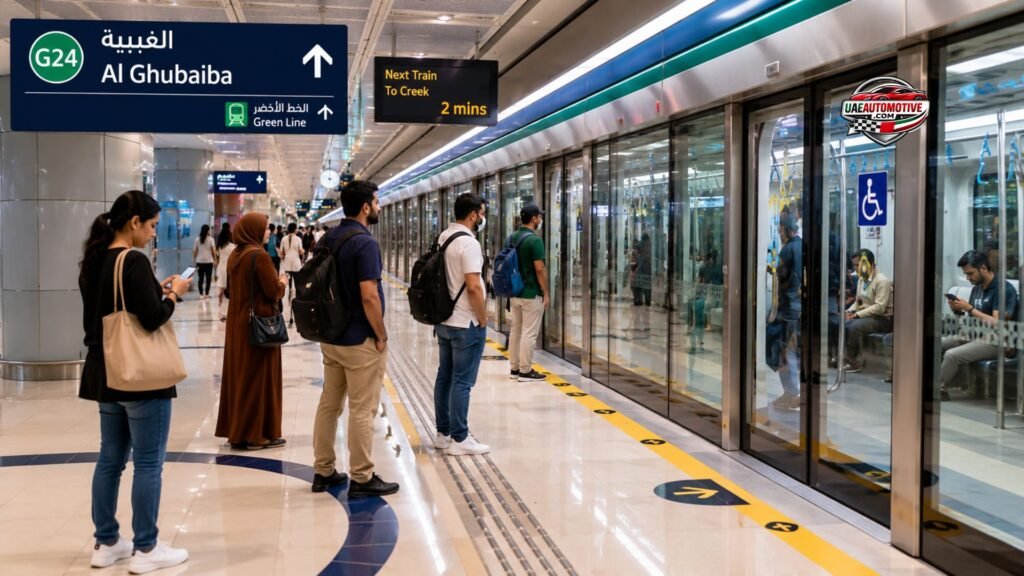
| Peak Train Frequency | Every 2–3 minutes |
| Off-Peak Frequency | Every 5–7 minutes |
| Multimodal Connections | Metro · Bus · Intercity Coach · Abra · Ferry |
| Accessibility | Fully wheelchair accessible |
| Future Development | Gold Line western terminus (opening 2032) |
Where It Sits and Why That Matters
Al Ghubaiba Metro Station sits near the junction of 51 Road and Al Ghubaiba Road in Al Shindagha, Bur Dubai. On a map that looks unremarkable. In reality, Al Shindagha is the oldest inhabited area of the city — this is where the ruling Al Maktoum family originally settled, where Dubai’s creek-based trading economy was born, and where the neighborhood still carries the texture of that history in its architecture and street life.
The station has multiple exits. Exit 1 faces Al Ghubaiba Road and gives the quickest access to the bus station. Exit 2 is better positioned for bus stop connections and the Creek-facing side. If you exit from the wrong side, you’ll spend five unnecessary minutes walking around — which matters in Dubai’s summer heat.
Google Map View
Green Line Route from Al Ghubaiba
Al Ghubaiba is station G24 on a 22.5 km line that runs between Etisalat (G11) in the east and Creek (G30) in the west. The underground section — which includes Al Ghubaiba — runs between Union and BurJuman.
Stations in Both Directions
| Direction | Station | Notes |
| ◀ North | Al Ras (G23) | 1 stop — near Gold & Spice Souks |
| ◀ North | Baniyas Square (G21) | Commercial hub |
| ◀ North | Union (G20) | Red Line transfer |
| ◀ North | Al Qiyadah (G11) | Northern terminus |
| South ▶ | Al Fahidi (G25) | 1 stop — heritage district |
| South ▶ | BurJuman (G26) | Red Line transfer |
| South ▶ | Oud Metha (G27) | Hospital area |
| South ▶ | Dubai Healthcare City (G28) | Medical cluster |
| South ▶ | Creek (G30) | Southern terminus |
The Two Transfer Options to the Red Line
You’ll need the Red Line for Dubai Mall, Business Bay, the Marina, or the airport. You have two transfer choices:
- Union Station (northbound, 4 stops): Generally faster for the airport or anything on the upper Red Line corridor.
- BurJuman Station (southbound, 2 stops): Better if you’re heading toward Downtown Dubai or Khalid bin Al Waleed. It’s also directly integrated with BurJuman Centre mall if you want to duck into air-conditioning mid-journey.
Both transfers take under five minutes on foot. Signs inside both stations are clearly marked in Arabic and English.
Station Timings
Standard Weekly Schedule
| Day | First Train | Last Train |
| Monday – Thursday | 5:00 AM | 12:00 AM (midnight) |
| Friday | 5:00 AM | 1:00 AM |
| Saturday | 5:00 AM | 12:00 AM |
| Sunday | 8:00 AM | 12:00 AM |
The Sunday start time catches people every single week. If you’re planning an early Sunday departure, a taxi to your first stop is the practical solution — or know in advance that no metro arrives before 8 AM.
Timings also shift during Ramadan (shorter early mornings, extended late nights) and UAE public holidays like National Day. The RTA S’hail app is the most reliable real-time source — download it before you travel, not when you’re standing at the gate.
Peak Hours at Al Ghubaiba
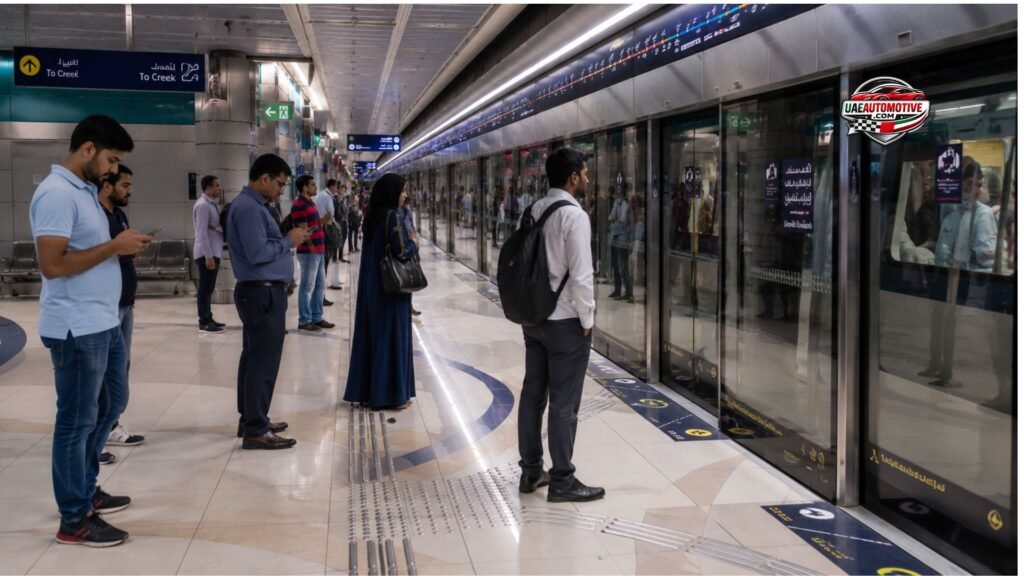
Rush hours here feel heavier than at many Green Line stations because the station feeds both a large residential area and the Al Ghubaiba Bus Station traffic simultaneously:
- Morning peak: 7:00 AM – 9:30 AM (heavy outbound commuter traffic)
- Evening peak: 5:30 PM – 8:00 PM (buses arriving, workers returning)
- Comfortable travel window: 10:00 AM – 4:00 PM on weekdays
NOL Card Fares
Dubai Metro operates on a 7-zone fare structure. Al Ghubaiba sits in Zone 6. Your fare is determined by how many zones your journey crosses — not by distance or specific stations.
Fare Table (NOL Card)
| Zones Crossed | Silver Card | Gold Card |
| 1 Zone | AED 3.00 | AED 6.00 |
| 2 Zones | AED 5.00 | AED 10.00 |
| 3–5 Zones | AED 6.50 | AED 13.00 |
| 6–7 Zones | AED 7.50 | AED 15.00 |
Daily cap: Silver and Blue NOL card holders pay a maximum of AED 14 per day, regardless of how many journeys they take. If you’re doing a full day of Old Dubai sightseeing with multiple hops, that cap makes the metro genuinely cost-effective.
Which NOL Card Should You Get?
| Card Type | Best For | Notes |
| Silver Card | Most travelers, tourists | Rechargeable, eligible for day/monthly passes |
| Gold Card | Those wanting premium cabins | Higher fares, access to Gold Class car |
| Blue Card | Students, seniors, people of determination | Concessionary fares, requires registration |
| Red Ticket | One-off occasional use | Paper-based, higher per-journey cost |
Cash is not accepted at metro gates. No exceptions. Get your NOL card from any vending machine before approaching the turnstile.
Useful Journey Costs from Al Ghubaiba
| Destination | Approx. Fare (Silver) | Approx. Time |
| Dubai International Airport | AED 6.50 | 25–30 min |
| Dubai Mall | AED 6.50 | 20–25 min |
| Gold Souk (via abra) | AED 1 (abra only) | 10 min |
| BurJuman Mall | AED 3.00 | 5–8 min |
| City Centre Deira | AED 3.00–5.00 | 12–15 min |
The Bus Station Connection: Al Ghubaiba’s Real Superpower
This is what separates Al Ghubaiba from almost every other metro stop in Dubai.
Right next to the metro station is Al Ghubaiba Bus Station — one of Dubai’s primary intercity bus terminals. People traveling to and from Abu Dhabi, Sharjah, Ajman, and other emirates pass through here constantly. That means this metro stop functions as a multimodal gateway in both directions: you can arrive by long-distance coach and step directly into the metro network, or leave the metro and board a bus to another emirate without any taxi fare in between.
Getting Between Metro and Bus Station
- Walking (Exit 1): 5–7 minutes. Cross Al Ghubaiba Road and follow signs. Best option in cooler months.
- By Bus (Exit 2): Routes 4, 4A, 32C, and E400 stop directly outside. Takes 2–3 minutes. Use your NOL card. Good option if you’re carrying luggage or traveling in summer.
Key Intercity and Local Bus Routes
| Route | Goes To |
| E100 | Abu Dhabi Central Bus Station |
| E400 | Sharjah |
| E306 | Ajman |
| X13 | Cross-city express |
| 4 / 4A | Local Bur Dubai coverage |
| 32C | Local city routes |
| 33 / 66 | Additional local routes |
| N55 | Night bus service (starts 3:00 AM) |
Bus station hours: Daily 5:00 AM – midnight. Intercity services generally 5:30 AM – 11:00 PM depending on route. All buses accept the NOL card.
One practical note if you’re taking an intercity coach: for popular routes like Abu Dhabi on Thursday evenings or Sunday mornings, arrive at the bus station 15–20 minutes before departure. Seats fill quickly and there are no assigned numbers on many services.
The Abra: One Dirham, Unmissable
Here’s something the majority of transit guides to Al Ghubaiba either skim over or ignore entirely.
A short walk from the station is the Dubai Creek abra dock. An abra is a traditional wooden water taxi — the same design, more or less, that’s been crossing this stretch of the Creek for over a century. The crossing from Bur Dubai to Deira costs AED 1 per person and takes about four minutes.
Why does this matter practically?
Because the Gold and Spice Souks are on the Deira side. Instead of riding the metro north to Al Ras or Gold Souk station (2–3 stops, plus walking time), you can walk 8 minutes from the metro to the abra dock, pay one dirham, and arrive at the Deira waterfront in under 15 minutes total. It’s faster, cheaper, and far more atmospheric than any metro ride.
The marine transport area near Al Ghubaiba also connects to RTA Ferry routes FR1 and FR5 for longer waterfront journeys. If you’re exploring Dubai by water — and the Creek is genuinely beautiful in the evening light — this station gives you the easiest access point in the city.
Station Design: The One That’s Different
Most Dubai Metro stations feel like modern transit infrastructure — functional, glass-heavy, clean. Al Ghubaiba doesn’t look like the others.
The design incorporates traditional Emirati architectural elements: wind towers (barjeel), oriel windows (mashrabiya), arched entryways, and sand-colored exterior finishes with wooden detailing. The surface-level entrances reference the wind-tower vernacular that defines the surrounding heritage district. Inside, arches and carved motifs echo the old buildings of Al Shindagha just steps away.
This was a deliberate choice. The station sits in a UNESCO-adjacent heritage zone, and the architects made the building feel like it belongs to its neighborhood rather than contradicting it. It’s one of the few metro stations in the world where the architecture itself functions as an introduction to the area you’re about to explore.
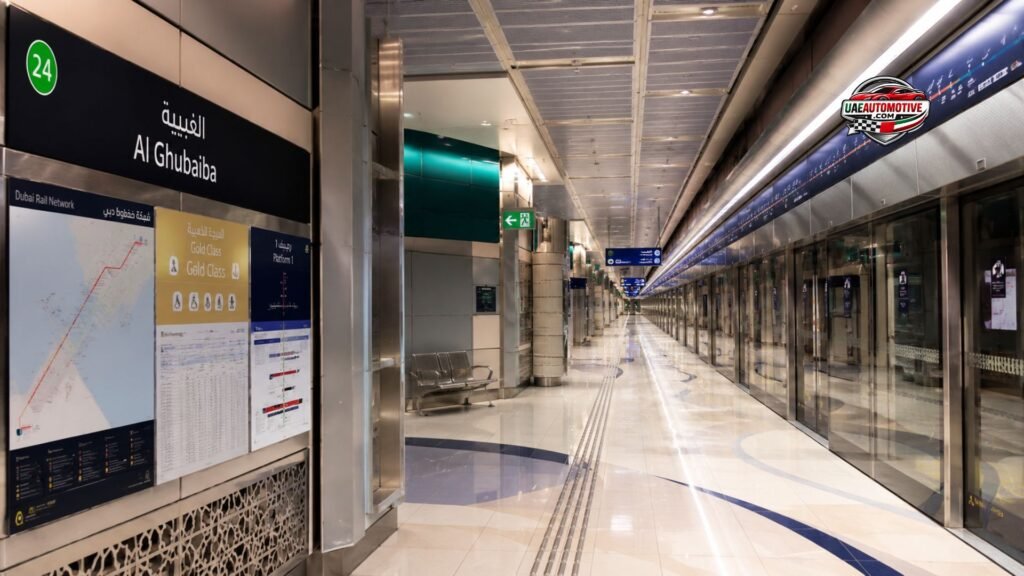
The station structure is underground with two floors — the upper platform serves trains heading north toward Union and Etisalat; the lower platform serves trains heading south toward BurJuman, Dubai Healthcare City, and Creek. Full-height platform screen doors are installed on both levels, maintaining the climate-controlled environment and preventing track access. The entire system runs on a Communication-Based Train Control (CBTC) driverless system, with minimum headways of around 90 seconds during peak periods.
What’s Around Al Ghubaiba on Foot
The station’s surroundings reward exploration. This part of Dubai is dense with things that don’t appear in most “top 10 Dubai” lists — precisely because they’re not malls or observation decks.
Within 10 Minutes Walking
Al Fahidi Historical Neighbourhood
The most authentically preserved pre-oil Dubai that exists. Narrow sikkas (alleyways), traditional wind-tower houses repurposed as art galleries and cafés, the XVA Art Hotel, the Coffee Museum, and the Sheikh Mohammed Centre for Cultural Understanding. Dubai Museum sits inside Al Fahidi Fort — the oldest building in Dubai, dating to around 1787.
Dubai Creek Waterfront
Walking along the Bur Dubai side of the Creek in the early morning or evening is one of the better free activities in Dubai. Dhow boats, abra crossings, the occasional pelican. The waterfront promenade connects to Al Seef, a more recently developed riverside area with cafés and restaurants built in a traditional aesthetic.
Textile Souk (Bur Dubai Souk)
A covered market selling fabrics, traditional clothing, souvenirs, and accessories. Lower pressure than the Gold Souk across the Creek — vendors are present but the atmosphere is calmer. Good for picking up a kandura, embroidered fabrics, or traditional textiles at negotiated prices.
Shindagha Museum
Genuinely undervisited and genuinely good. The museum occupies a cluster of traditional buildings and covers Emirati maritime heritage, pearl diving, falconry, and the area’s history as a ruling family residence. Far less crowded than Dubai Museum and arguably more engaging for visitors interested in understanding how this city actually developed.
City Centre Al Shindagha
A shopping mall directly adjacent to the station. Not Dubai Mall — but it has a VOX Cinemas multiplex (7 screens), a Carrefour, and the standard range of UAE retail brands. Useful to know about if you need air-conditioning, groceries, or a cinema trip while in the area.
Slightly Further (Under 20 Minutes by Transport)
| Attraction | How to Get There | Time |
| Gold Souk, Deira | Abra from Creek | ~10 min |
| Spice Souk, Deira | Abra from Creek | ~10 min |
| Dubai Frame | Bus C09 from nearby stop | ~20 min |
| Global Village (seasonal) | Bus from Al Ghubaiba Bus Station | ~30 min |
| Dubai Mall | Metro (Green → Red at BurJuman) | ~22 min |
| Airport Terminal 1 | Metro (Green → Red at Union) | ~28 min |
Food Near the Station: Where to Actually Eat
The blocks around Al Ghubaiba are among the best places in Dubai for genuine, affordable food — not tourist approximations, but restaurants serving working-class communities who demand the real thing.
What to Look For
- Pakistani dhabas along Al Fahidi Street: rice dishes, karahi, grilled meats at AED 15–25 for a full meal
- Irani cafés: sweet tea, soft lavash bread, eggs, and feta. Often open from early morning. Good for a pre-commute breakfast under AED 10
- Shawarma counters: scattered throughout, open late. The Bur Dubai shawarma style tends to lean heavier on garlic sauce than the Deira version
- Juice bars: sugarcane juice is everywhere and costs AED 3–5
- Arabic sweets shops: luqaimat (fried dough balls with date syrup and sesame), kunafa, and umm ali if you’re lucky
Friday midday (roughly 12:30–2:00 PM): many smaller shops and restaurants near the souk close for Jumah prayers. Plan meals around this window if you’re visiting on a Friday.
Station Facilities
Al Ghubaiba is well-equipped for the volume of traffic it handles:
- Ticket vending machines and NOL top-up kiosks on the concourse
- Customer service counter — genuinely useful for route help, especially for first-time intercity bus connections
- Convenience stores and food outlets inside the station
- Restrooms (clean and maintained)
- Digital information displays showing real-time train arrivals
- Free Wi-Fi throughout (RTA-provided, consistent connection)
- Elevators and escalators to both platform levels
- Tactile guidance paths for visually impaired passengers
- Over 9,000 CCTV cameras across the metro network; emergency call boxes available
- Dedicated Women & Children cabin access — first and last cars of each train
Accessibility
Al Ghubaiba is fully accessible. Elevators connect street level to both platform levels. Ramps are installed where needed. Tactile floor paths guide visually impaired passengers from entrances to platforms. Accessible ticket gates accommodate wheelchairs and mobility aids. Trains have dedicated wheelchair spaces.
Families with strollers navigate the station without difficulty — the elevator layout is straightforward and the concourse is wide enough to handle busy periods without bottlenecks.
The Gold Line: Why Al Ghubaiba Just Got Much More Important
This is the part no other current guide covers.
On 22 April 2026, Sheikh Mohammed bin Rashid Al Maktoum announced the Dubai Metro Gold Line — described as the largest transport project in Dubai’s history. The line is 42 km long, fully underground, costs AED 34 billion, includes 18 stations across 15 strategic districts, and is scheduled to open on 9 September 2032.
Al Ghubaiba is the starting point — the western terminus of the entire Gold Line.
The route runs from Al Ghubaiba through Mina Rashid, City Walk, Business Bay, Mohammed Bin Rashid City, Meydan, Al Barsha South, Jumeirah Village Circle, Dubai Production City, and terminates at Jumeirah Golf Estates. It will connect with:
- The Green Line at Al Ghubaiba (interchange already in place)
- The Red Line at Business Bay and Jumeirah Golf Estates
- Etihad Rail (UAE national passenger rail) at Meydan and Jumeirah Golf Estates
When it opens, Al Ghubaiba will become a triple-line interchange — one of only a handful of such stations in the entire Middle East. Daily ridership projections for the Gold Line alone reach 465,000 passengers by 2040. The station that currently serves 20,000 people per day will be transformed into a major network hub.
For anyone making long-term decisions about where to live or work in Dubai, this is the most consequential piece of transport infrastructure the city has announced since the original metro opened in 2009.
Practical Tips That Most Guides Miss
Exit 1 vs Exit 2: Exit 1 is for the bus station and Al Ghubaiba Road. Exit 2 faces the bus stops and is quicker if you’re taking a local bus connection. Know which one you need before you arrive.
The AED 1 abra is faster than the metro for the Gold Souk. This surprises people. Walk 8 minutes to the Creek dock, take the abra (AED 1), arrive at Deira waterfront in 4 minutes. Total: ~15 minutes. Via metro to Gold Souk station: ~12–15 minutes plus exit walking. Both are similar in time, but the abra is more enjoyable and significantly cheaper.
Don’t rely on paper tickets. Paper-based Red Tickets cost more per journey than NOL Silver Cards and can only hold limited single journeys. If you’re in Dubai for more than a day, the Silver Card pays for itself quickly.
Sunday morning is a gap. The metro doesn’t run until 8:00 AM on Sundays. Plenty of people — especially weekend visitors — find this out the hard way at 6:30 AM.
ATMs near the station: There are ATMs in the City Centre Al Shindagha mall, which is literally adjacent to the metro exit. If your NOL card needs topping up and the in-station kiosk is busy, cash withdrawal is close by.
Evenings are beautiful here. The Creek waterfront near Al Ghubaiba, lit up after sunset with the dhow boats and the old buildings behind them, is one of the most photogenic scenes in Dubai that doesn’t appear in every tourist brochure. Worth staying in the area past dark if your schedule allows.
Common Mistakes to Avoid
Getting on the wrong platform level. The upper platform goes north (toward Union, Al Ras, and Etisalat). The lower platform goes south (toward Al Fahidi, BurJuman, and Creek). Signs are clear once you know to look, but first-time passengers occasionally take the wrong direction.
Assuming the Green Line reaches everywhere. Dubai Marina, Palm Jumeirah, and JBR are on the Red Line. From Al Ghubaiba, you must transfer first. Plan your route on the RTA app rather than assuming a direct connection.
Walking to nearby attractions in summer without preparation. Al Fahidi is a 10-minute walk. In July or August, that 10 minutes in 42°C heat with humidity is genuinely unpleasant. Either go early morning, take a bus for short hops, or plan heritage walks for October–March.
Traveling without a topped-up NOL card. Vending machines at peak times have queues. The RTA app lets you top up your registered card remotely, which is faster than fumbling with cash and a machine while a queue forms behind you.
Don’t Forget To Read It: DMCC Metro Station
Frequently Asked Questions
What line is Al Ghubaiba Metro Station on?
The Green Line, coded G24. It’s not on the Red Line. To access the Red Line, take the Green Line north to Union Station or south to BurJuman Station and transfer there.
How do I get from Al Ghubaiba to Dubai Mall?
Take the Green Line southbound to BurJuman, switch to the Red Line, and exit at Burj Khalifa/Dubai Mall Station. Total journey is around 20–25 minutes. Fare: approximately AED 6.50 with a Silver NOL card.
Is there a bus to Abu Dhabi from Al Ghubaiba?
Yes. Route E100 runs from Al Ghubaiba Bus Station to Abu Dhabi Central Bus Station. The bus station is a 5–7 minute walk from the metro via Exit 1. Arrive 15 minutes early on busy travel days.
How close is Dubai Museum to Al Ghubaiba Metro?
A 3–5 minute walk. Head toward Al Fahidi Street after exiting the station — the museum is inside Al Fahidi Fort, which is easy to spot from the street.
Does Al Ghubaiba connect to the Gold Line?
Not yet. The Gold Line was announced in April 2026 and is scheduled to open on 9 September 2032. Al Ghubaiba will be the starting point (western terminus) of the new line, turning it into a triple-line interchange.
Is the station wheelchair accessible?
Fully. Elevators connect all levels, ramps are installed throughout, tactile floor paths guide visually impaired passengers, and all gates have accessible lanes. Trains also have dedicated wheelchair spaces.
What are the cheapest things to do near Al Ghubaiba Metro?
The abra crossing to Deira (AED 1), walking through Al Fahidi Historical Neighbourhood (free), the Textile Souk (free to browse), and the Creek waterfront promenade (free). A full half-day of Old Dubai exploration from this station can cost almost nothing beyond transport.
Does the station have free Wi-Fi?
Yes. The RTA provides free Wi-Fi throughout the station, as it does across the Dubai Metro network.
Al Ghubaiba Metro Station has always been useful. By 2032, it’ll be one of the most important transit junctions in the Gulf. Right now, it’s the rare metro stop that earns its visit for reasons completely unrelated to transit — the food, the history, the creek, the architecture, the abra ride that costs one dirham and delivers more than most AED 200 tours in this city.
For real-time updates on train timings, NOL fares, and service changes, check the RTA S’hail app or visit the official RTA website before traveling.
