
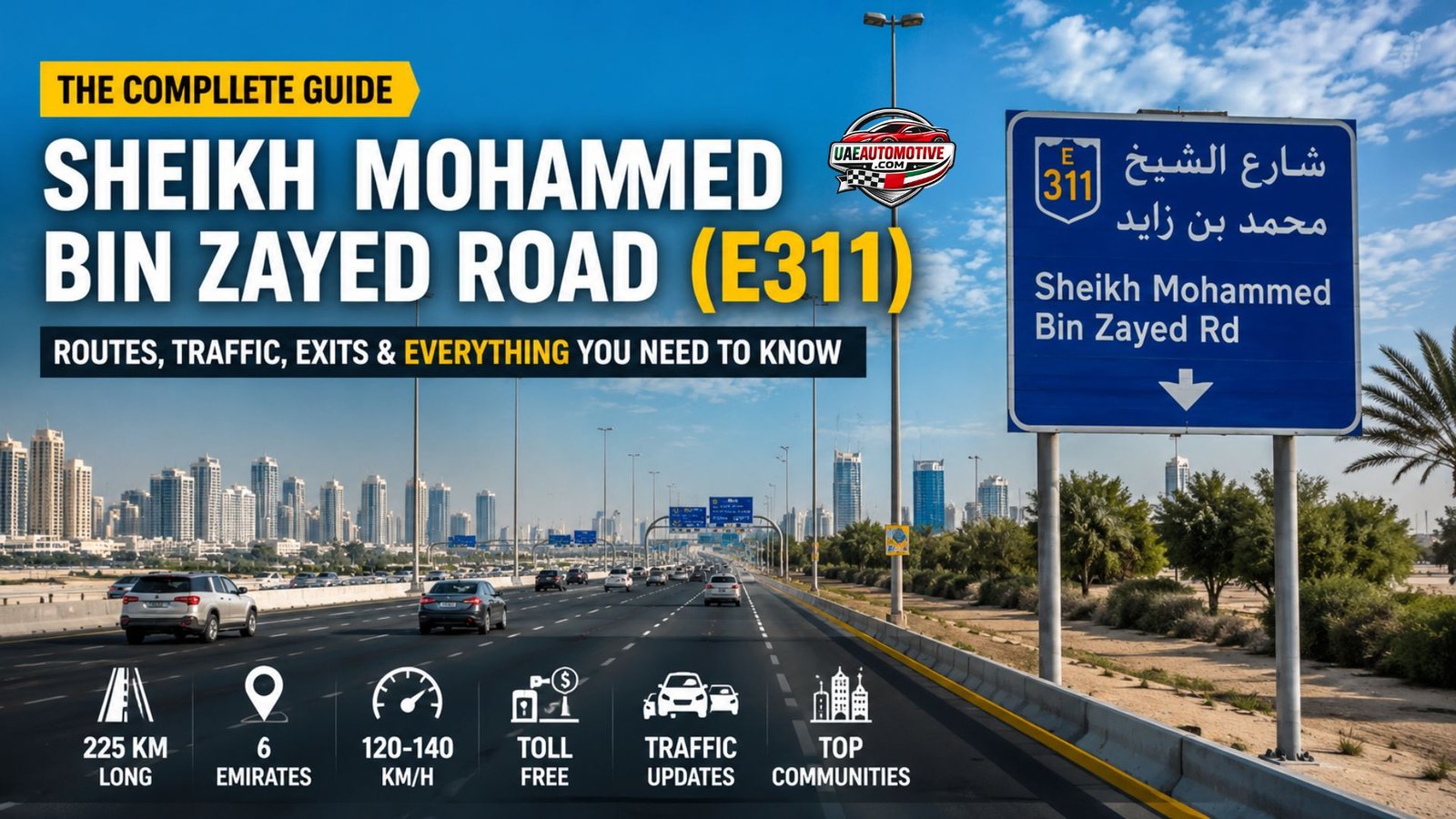
Ask any long-time UAE resident which road they actually rely on, and the answer is rarely Sheikh Zayed Road. That one gets the tourists and the postcards. E311 gets the commuters, the freight trucks, the families who moved to Arabian Ranches because it was close to this road, and the logistics companies who chose Dubai Investment Park for the exact same reason.
Sheikh Mohammed Bin Zayed Road (E311) is the UAE’s real workhorse highway. It runs 225 kilometers from Abu Dhabi’s suburban edge to the northern tip of Ras Al Khaimah, connecting six emirates without a single toll gate. Millions of people drive it every week. Entire neighborhoods were built because of it. And right now, with Al Maktoum International Airport transforming the Dubai South corridor into the most active construction zone in the region, E311 is becoming even more important than it already was.
If you live in the UAE, commute across emirates, are thinking about where to buy or rent property, or just want to understand how this country actually moves, this is the guide worth reading.
Have A Look On It: Sheikh Ammar Bin Humaid Street
- Quick Overview
- How This Road Got Its Name
- The Route: What It Passes Through
- Speed Limits and Road Rules
- Real Traffic: What Commuters Actually Face
- Major Interchanges and Key Exits
- Living Near E311: The Real Estate Picture
- The Logistics and Economic Role
- Safety: From Most Dangerous to Significantly Improved
- E311 vs. E11 vs. E611: Choosing the Right Route
- What You Don't Know About It
- Sheikh Mohammed Bin Zayed Road (E311) FAQs
Quick Overview
| Detail | Info |
| Official Name | Sheikh Mohammed Bin Zayed Road |
| Highway Code | E311 |
| Former Name | Emirates Road (renamed January 2013) |
| Total Length | Approx. 225 km |
| Start Point | New Al Falah, Abu Dhabi |
| End Point | Al Rifah, Ras Al Khaimah |
| Emirates Covered | Abu Dhabi, Dubai, Sharjah, Ajman, Umm Al Quwain, Ras Al Khaimah |
| Speed Limit | 120–140 km/h (varies by section) |
| Toll | None, fully toll-free |
| Max Lanes | Up to 12 lanes (6 per direction on key sections) |
| Parallel Highway | Sheikh Zayed Road (E11), further inland |
| Key Alias | MBZ Road, SMBZ Road |
How This Road Got Its Name
The highway didn’t always carry this name. For most of its early life, it was called Emirates Road. That name reflected the original intent: a national bypass running parallel to the coastal E11, designed to take pressure off the downtown core as Dubai and Abu Dhabi were expanding at a pace that had caught everyone slightly off guard.
On 1 January 2013, Sheikh Mohammed bin Rashid Al Maktoum, Ruler of Dubai, ordered the road be renamed Sheikh Mohammed Bin Zayed Road, in tribute to General Sheikh Mohammed bin Zayed Al Nahyan, then Crown Prince of Abu Dhabi, for his contribution to building a connected, inclusive UAE. The renaming wasn’t decorative. It coincided with a major infrastructure push, including the extension of the highway’s Abu Dhabi section that was later completed in November 2016, connecting Jebel Ali Free Zone directly to New Al Falah at a project cost of US$2.1 billion.
The old “Emirates Road” name didn’t disappear. It was transferred: what had previously been the Dubai Bypass Road became E611, now officially Emirates Road. So if you’re searching on a map and seeing both names, that’s why.
Today most residents simply call it MBZ Road or E311. Both are accurate.
The Route: What It Passes Through
Think of E311 as a diagonal line crossing the UAE from southwest to northeast, running inland and parallel to the coast.
Abu Dhabi
The road begins at New Al Falah, a suburban residential district on Abu Dhabi’s eastern boundary. From there it moves northeast through the capital’s outskirts, passing near Masdar City and the Mussafah industrial zone. This section is relatively uncongested. It was the last major piece of the E311 network to be completed, and it transformed what was once a Dubai-centric road into a true inter-emirate corridor connecting both major cities without touching the urban core of either.
Dubai
The Dubai section is where the highway becomes most complex and most populated. E311 runs east of Sheikh Zayed Road, sitting further inland. On both sides of the road, entire communities have been developed specifically because of its access points.
Key areas inside Dubai accessible via E311:
- Dubai Silicon Oasis: A tech and residential free zone with its own dedicated exit
- Arabian Ranches: One of Dubai’s most established villa communities; its E311 access was a central part of its original appeal
- Mirdif and Al Khawaneej: Older, settled residential suburbs that depend on E311 for daily commuting
- International City: High-density, affordable housing that houses hundreds of thousands of residents
- Dubailand: The broader development zone stretching across this corridor
- Global Village: A seasonal attraction drawing millions of visitors annually, directly accessible from E311
- Dubai South and Dubai Investment Park (DIP): Industrial, commercial, and residential zones positioned next to Al Maktoum International Airport
- Jebel Ali Free Zone (JAFZA): Accessible via interchange connections; one of the world’s largest free zones by trade value
Sharjah and Ajman
North of Dubai, the road passes through Sharjah’s industrial zones and outer residential areas before entering Ajman. This section carries the heaviest congestion on the entire route, a structural problem driven by the daily mass movement of workers and professionals who live in Sharjah but work in Dubai. Rents are significantly cheaper across the border in Sharjah, so the migration is predictable and largely unavoidable given current housing economics.
In Ajman, E311 connects toward Al Nuaimiya and the city center.
Umm Al Quwain and Ras Al Khaimah
The road continues northward through Umm Al Quwain’s developing landscape before terminating at Al Rifah in Ras Al Khaimah. These northern sections are calm. Traffic thins considerably once you clear Sharjah, and the road runs at its posted limits comfortably. The extension to Ras Al Khaimah was completed in mid-2005, cementing E311’s status as a genuinely national corridor.
Speed Limits and Road Rules
Speed Limits by Section
| Section | Speed Limit |
| Open highway, general | 120–140 km/h |
| Near urban interchanges | 100–120 km/h |
| Adverse weather (fog, rain, sandstorm) | Variable, posted digitally |
| Heavy vehicle / truck lanes | Lower limits, camera-enforced |
One change worth knowing: the old rule requiring a minimum speed of 120 km/h in fast lanes on E311 was removed. That rule used to result in AED 400 fines for drivers caught going slower, even if traffic conditions forced it. The removal has made the fast-lane experience considerably less stressful.
The fast lane is still for overtaking only. Cruising without intent to pass will earn you an AED 400 fine, a policy reinforced by Dubai Police in December 2025. The message is specific: the left lane is not a comfort zone, it is a passing lane.
Speed Cameras
Fixed cameras are stationed at regular intervals. Mobile enforcement is also active, particularly on the Dubai and Sharjah sections. The cameras are integrated with vehicle registration records, meaning fines follow you regardless of which emirate you’re driving through when they’re issued.
Toll Status
E311 is fully toll-free. No Salik gates anywhere on the route. This is a genuine differentiator from E11, where Salik tolls were restructured in January 2025: AED 6 during peak hours (6–10 AM and 4–8 PM) and AED 4 during off-peak periods. For someone doing a Sharjah-to-Dubai round trip daily, that’s a meaningful daily cost. The toll-free nature of E311 is precisely why the road attracts so much traffic and why the Sharjah–Dubai corridor on it is so consistently jammed.
Real Traffic: What Commuters Actually Face
There’s a difference between what a road is designed to handle and what daily life on it looks like. On E311, that gap is widest in one specific corridor.
The Sharjah–Dubai Problem
The stretch between the Dubai–Sharjah border and major Dubai interchanges is one of the most congested road segments in the entire UAE. Surveys consistently show that over 90% of Dubai and Sharjah residents report regular traffic jams during commuting hours. On E311 specifically:
- Southbound (Sharjah to Dubai): Congestion builds from as early as 5:00 AM. Peak gridlock hits between 6:30 and 9:00 AM. Conditions generally don’t clear until around 11:00 AM.
- Northbound (Dubai to Sharjah): Traffic starts stacking around 4:00 PM. Worst congestion is 5:00–7:00 PM. Roads begin clearing around 8:00–9:00 PM.
The September 2024 opening of two new bridges at the Garn Al Sabkha–E311 intersection reportedly cut rush-hour travel time at that specific junction by up to 70%. It helped. But it addressed one bottleneck on a corridor that has several.
Where It Flows Well
- The Abu Dhabi section, especially after New Al Falah toward Mussafah and beyond
- Sections through Umm Al Quwain and Ras Al Khaimah
- Mid-day on almost any section (roughly 10:00 AM to 3:30 PM)
- Friday mornings and public holiday periods
Timing Tips That Actually Work
| Journey | Avoid | Best Window |
| Sharjah to Dubai (southbound) | 6:30 AM – 9:30 AM | Before 5:30 AM or after 10:30 AM |
| Dubai to Sharjah (northbound) | 4:00 PM – 7:30 PM | Before 3:30 PM or after 8:30 PM |
| Abu Dhabi to Dubai | No extreme peak; mild buildup mid-morning | Flexible, mid-morning works |
| Dubai to RAK or Fujairah | Standard Dubai exit hours | Mid-morning onward |
Major Interchanges and Key Exits
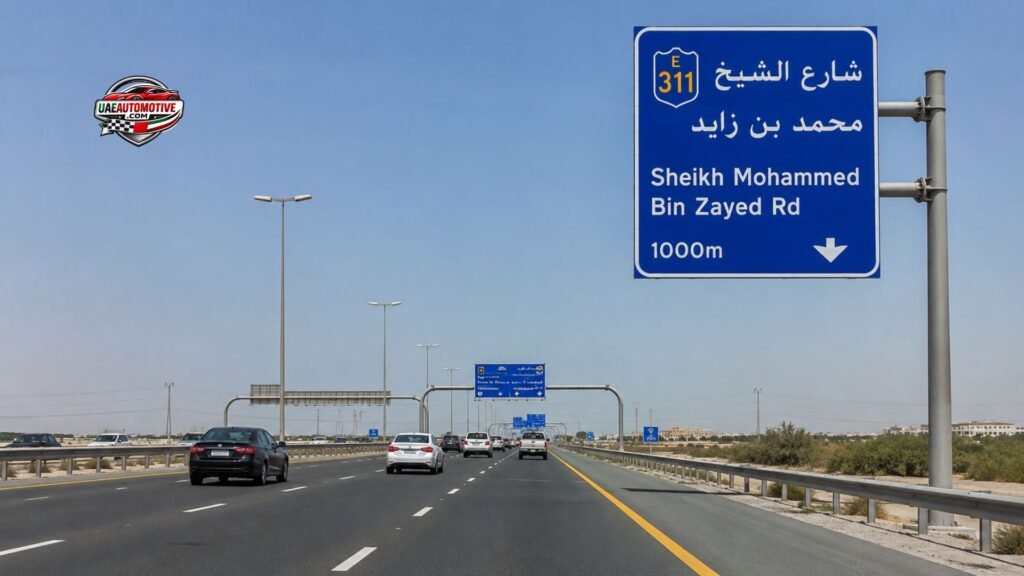
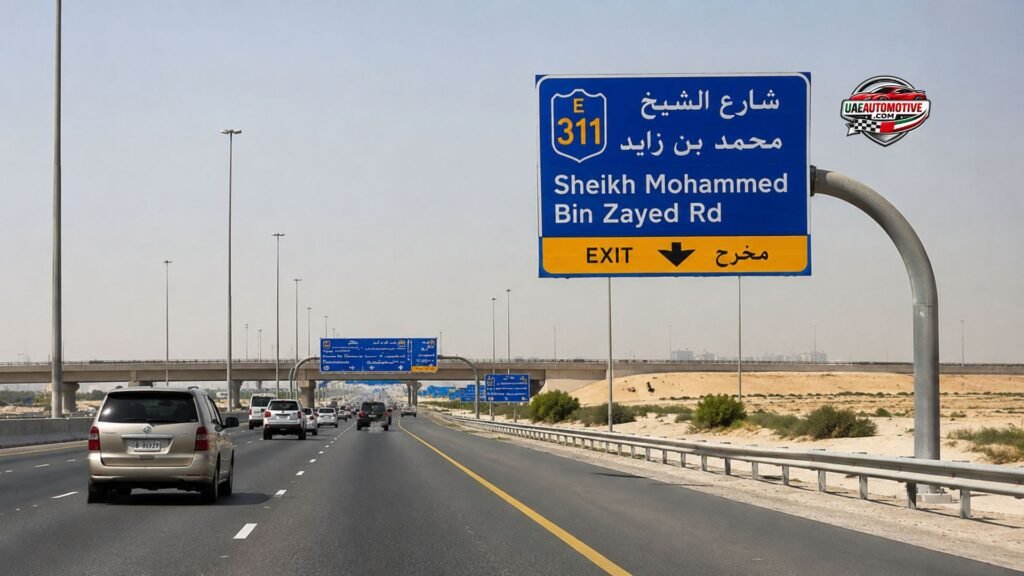
E311 has dozens of access points. These are the most important ones for drivers, residents, and logistics planners.
| Interchange / Exit | Significance |
| Jebel Ali / JAFZA Interchange | Gateway to world’s largest free zone; Abu Dhabi section start |
| Al Khail Road (E44) Interchange | Inner Dubai access; connects toward Jebel Ali Port |
| Dubai–Al Ain Road (E66) Interchange | Eastern Abu Dhabi and Al Ain access |
| Dubai Silicon Oasis Exit | Tech free zone, residential community |
| Mirdif / Al Khawaneej Exits | Established suburban communities |
| International City Exit | High-density affordable residential zone |
| Global Village / Dubailand Exit | Entertainment corridor; seasonal events |
| Arabian Ranches Interchange | Premium villa community |
| Dubai South / DIP Exit | Al Maktoum Airport; industrial zone |
| Muhaisnah Interchanges | Workers’ accommodation and small commercial zones |
| Garn Al Sabkha Interchange | Upgraded 2024, significantly reduced congestion at this node |
The Dubai South exit deserves special attention. With Al Maktoum International Airport’s AED 128 billion expansion underway, construction milestone in June 2026 confirmed more than 17,000 concrete piles completed and over 45 million cubic metres of excavation done. The West Terminal alone is an 800,000 sq.m. facility designed for 45 million passengers annually. When the airport begins major operations in 2032, the Dubai South exit from E311 will be handling a volume of freight and passenger traffic that current interchange capacity wasn’t designed for, and the RTA is already working on solutions.
Living Near E311: The Real Estate Picture
Some of Dubai’s most popular communities exist specifically because of E311. The road didn’t follow the development; the development followed the road.
Communities Built Around the Road
Dubai Silicon Oasis operates as a self-contained ecosystem: tech companies, apartment towers, schools, clinics, and retail all within walking distance of each other, all anchored to E311 access. It attracts professionals who want a structured, walkable community while staying connected to the broader city.
Arabian Ranches is one of Dubai’s most enduring villa communities. Spanish and Mediterranean architecture, golf courses, schools, and community retail. The E311 connection made it viable for families who might be commuting in different directions, toward Abu Dhabi one day and toward central Dubai another.
Mirdif is older, more established, and more diverse than its neighbors. Villa-heavy, with strong community infrastructure. Long-term Dubai residents who want a settled, less transient feel tend to end up here.
International City is honest about what it offers: affordable accommodation in a city where housing costs have climbed sharply. It houses hundreds of thousands of people and depends almost entirely on E311 for connectivity to everything else.
Town Square, The Villa, Al Furjan, Al Warqaa are among the communities that have grown significantly in value partly because they sit within reach of E311 interchanges. Developers priced this access into their projects from the beginning.
What Buyers and Renters Often Get Wrong
Proximity to E311 is not uniformly positive. Properties facing the road directly, especially near industrial interchange zones, can deal with significant noise from freight traffic during overnight hours. Trucks are redirected to E311 when restricted from other roads, meaning 2 AM is not necessarily quiet near certain exits.
The more intelligent positioning: within 3–5 minutes of an interchange, not directly alongside the road. That distance gives you the accessibility without the constant background roar.
The Dubai South corridor is a different story. Rents in Dubai Investment Park and Dubai South rose roughly 20% in 2025, driven by Emirates Airlines staff relocations and the airport construction workforce. Warehousing near the Jebel Ali–Al Maktoum “Sea-to-Air” corridor is reportedly 98% occupied. The window to enter this market at pre-2025 prices has likely already closed, but the growth trajectory for the corridor as the airport project advances through 2029–2032 remains among the strongest in the region.
The Logistics and Economic Role
E311 is not primarily a commuter road. In terms of economic impact, it functions as the country’s main inland freight corridor.
When the RTA restricted heavy vehicles from Sheikh Zayed Road (E11), E311 became the default truck route through Dubai. Industrial zones along its length: JAFZA, DIP, Mussafah, Sharjah’s industrial districts, and the new logistics clusters near Dubai South all depend on it. The “Sea-to-Air” corridor connecting Jebel Ali Port to Al Maktoum International Airport runs directly through the E311 corridor, with goods moving from container ships to aircraft in under four hours at full operation.
For any company evaluating a warehousing or manufacturing location in the UAE, E311 access is not a nice-to-have. It’s a baseline requirement that shapes how quickly goods move, how much last-mile logistics cost, and how easily staff can reach the site.
Safety: From Most Dangerous to Significantly Improved
Here’s something most guides quietly skip over. In the first six months of 2006, E311 recorded 19 fatalities within Dubai alone. It was formally cited as the UAE’s most dangerous road at the time.
The reason wasn’t recklessness alone. It was design. The original road had roundabouts at high-speed sections, a combination that produces predictable, violent outcomes. When RTA redeveloped the road in 2006 onward, replacing roundabouts with grade-separated interchanges and flyovers, widening to six lanes per direction, introducing comprehensive speed camera coverage, and improving lighting and lane markings, the safety profile changed dramatically.
The road today is one of the better-maintained in the country. Emergency lay-by areas, AI-assisted surveillance cameras, variable speed signage during fog events, and fast-response incident management are all in operation on the key sections.
That said, two hazards remain worth taking seriously:
Fog: The winter months (November through February) can bring visibility-reducing fog across sections of the Abu Dhabi approach and parts of southern Dubai. When variable speed signs activate during fog events, the limits are legally binding, not advisory. Accidents spike during fog periods every year on UAE highways.
Sandstorms: When one hits, the correct response is to exit the highway if possible, or pull into a safe lay-by, turn on hazard lights, and wait. Driving through a sandstorm at highway speed is genuinely dangerous regardless of how confident you feel about it.
E311 vs. E11 vs. E611: Choosing the Right Route
| Factor | E311 MBZ Road | E11 Sheikh Zayed Road | E611 Emirates Road |
| Tolls | None | AED 4–6 (Salik) | None |
| Speed limit | 120–140 km/h | 100–120 km/h | 110–140 km/h |
| Congestion | Heavy (Dubai–Sharjah) | Heavy (urban Dubai) | Moderate |
| Freight use | Primary truck corridor | Restricted for trucks | Heavy truck use |
| Urban access | East Dubai access | Central Dubai | Limited urban access |
| Best for | Sharjah–Dubai commute, freight | Urban movement, Abu Dhabi–Dubai | Long-haul bypass |
The realistic daily calculation most Sharjah–Dubai commuters face: E311 is free but can cost 60–75 minutes in peak traffic. E11 costs AED 6 but might save 20–30 minutes. A five-day working week at AED 6 per day, both ways, adds up to over AED 3,000 a year. Whether that’s worth paying depends on how much you value those minutes.
Some commuters alternate: E311 on good traffic days, E11 when running late. Both apps (Google Maps and Waze) now provide reliable live traffic data for E311, and the variable message signs on the road itself give real-time warnings before major decision points.
Don’t Forget To Read It: Al Taawun Street Sharjah
What You Don’t Know About It
A few things that come up in real driver experience but rarely appear in standard guides:
The exit sign problem. A handful of E311 exits are mapped differently in Google Maps versus the physical signage. Knowing your interchange number, not just your destination name, prevents last-second lane changes across multiple lanes of traffic.
The truck timing reality. When E611 sections close for maintenance, trucks are officially diverted to E311. These closures are announced on RTA social channels, but not always with much lead time. If you’re driving the Dubai South or Jebel Ali section in the early hours and notice unusually heavy freight traffic, a diversion is likely in effect.
Night is not necessarily quiet. Freight movement concentrates in the overnight hours specifically because trucking companies avoid peak congestion. Sections near industrial exits can be significantly busier between midnight and 4 AM than mid-afternoon.
The airport effect is already showing. The DWC expansion is still years from major operations, but the property market around Dubai South has already shifted. Rents are up 20%, warehousing space is effectively full, and the commuter population working on the construction project is growing. If you’re choosing a home near the Dubai South exit area right now, you’re not choosing what it is today; you’re choosing what it will look like in 2030.
Sheikh Mohammed Bin Zayed Road (E311) FAQs
Is E311 the same as Emirates Road?
No. E311 was previously called Emirates Road, but was renamed Sheikh Mohammed Bin Zayed Road in January 2013. The name “Emirates Road” was then assigned to E611, which had formerly been called Dubai Bypass Road. They are now two separate highways, each with distinct routes and purposes.
Does E311 have any Salik toll gates?
No. E311 is completely toll-free as of 2026. In contrast, E11 (Sheikh Zayed Road) has Salik charges of AED 6 during peak hours and AED 4 off-peak since the revised tariff in January 2025.
What is the actual speed limit on MBZ Road?
It varies. Most open sections allow 140 km/h. Sections near residential interchanges and urban zones typically carry 100–120 km/h limits. The old minimum speed rule of 120 km/h in fast lanes has been removed. Speed cameras enforce the posted limits throughout.
Why is the Dubai–Sharjah section so congested every morning?
It comes down to housing economics. A large proportion of Dubai’s workforce lives in Sharjah where rents are significantly lower. That creates a daily flood of commuters crossing the border in the morning and returning at night, all converging on a limited number of interchanges. The Garn Al Sabkha interchange improvements (2024) helped one bottleneck, but the structural issue remains.
Which communities near E311 are best for families?
Arabian Ranches, Mirdif, and Dubai Silicon Oasis are the most established options. Town Square and Al Furjan are newer but growing quickly. The Villa and Al Warqaa suit those wanting more space and quieter surroundings. Each has schools, retail, and healthcare within reasonable distance.
Is the Dubai South exit from E311 worth paying attention to for property?
Yes. The Al Maktoum International Airport expansion (AED 128 billion, Phase 1 targeting 2032) is transforming the Dubai South corridor. Property transactions in Dubai South crossed AED 15 billion in the first five months of 2025 alone. Warehousing near the area is at near-full occupancy. The E311 access to this zone will only grow in strategic importance as construction accelerates through 2026–2030.
What are the alternatives when E311 is congested?
E11 (Sheikh Zayed Road) if you don’t mind the Salik toll. E611 (Emirates Road) for a longer but often smoother run. E44 (Al Khail / Dubai–Hatta Road) for parts of the journey. During severe morning congestion, some commuters use surface roads through the Sharjah–Dubai border zone, though these too fill quickly.
What should I know about driving on E311 in fog or sandstorms?
Take variable speed signs seriously: they carry legal weight, not just advisory. In a sandstorm, exit the highway or pull into a lay-by and turn on hazard lights. If visibility drops to near-zero, turning off your headlights is actually safer as other drivers may follow your lights thinking you’re a moving vehicle. Both fog and sandstorm conditions concentrate in the Abu Dhabi and southern Dubai sections between November and February.
