

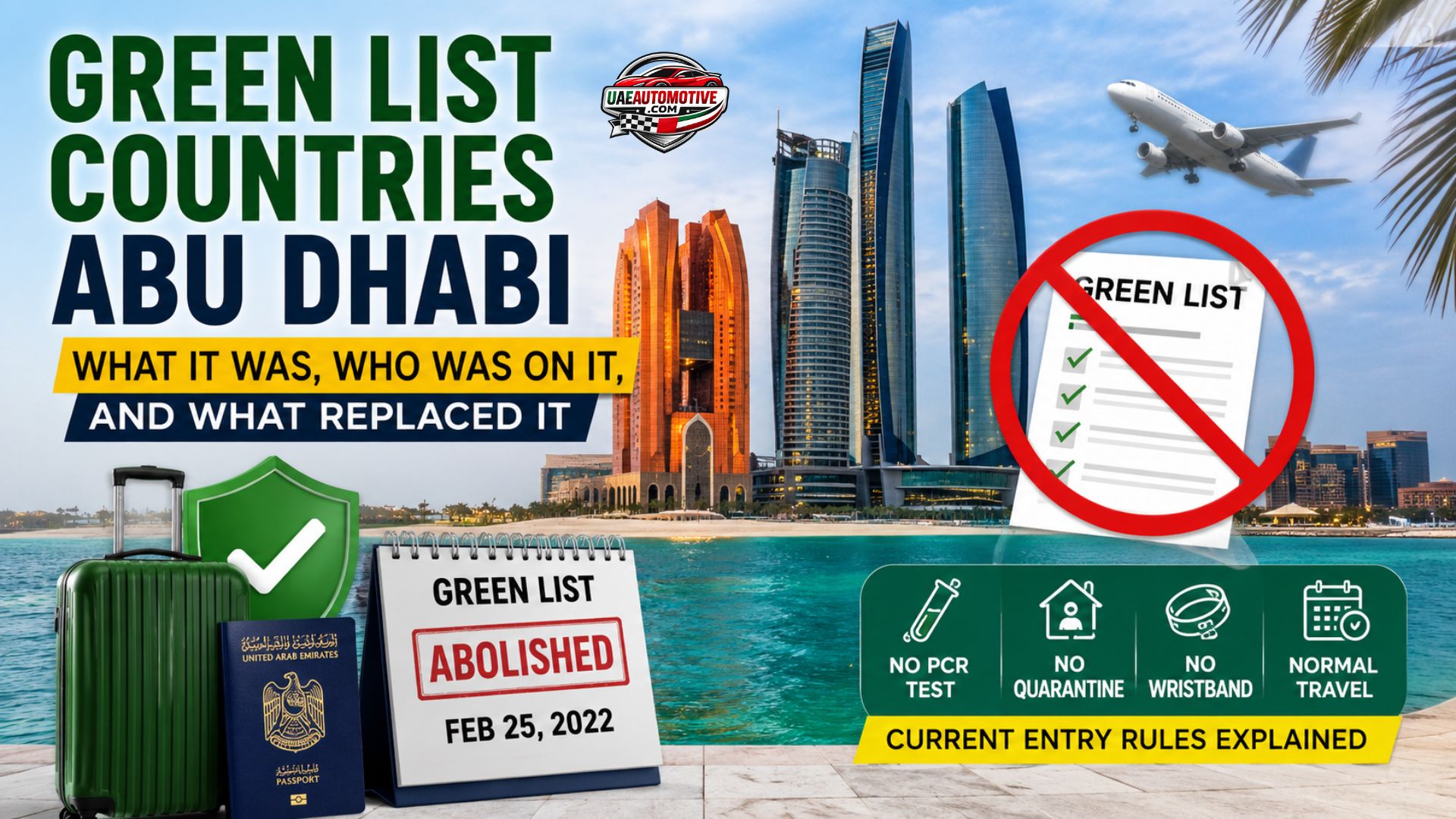
Stop. Before you read one more outdated article — here’s the truth nobody says clearly enough: Green List Countries Abu Dhabi was permanently abolished on February 25, 2022. It doesn’t exist anymore. There is no list to check, no country-by-country quarantine system, no wristband, no Day 6 PCR test. If a website is telling you to “check if your country is on Abu Dhabi’s Green List” right now in 2025 or 2026, that website is three years behind.
This is the article that covers everything — honestly, accurately, and without padding. What the Green List actually was, how it worked in practice, which countries were on it and when, why certain countries were excluded, what the wristband system involved, how Abu Dhabi compared to Dubai, and what entry to Abu Dhabi looks like for travelers today.
Have A Look On It: Ghantoot COVID Test
- Quick Facts
- What the Green List Actually Was — And What It Wasn't
- How It Actually Worked at the Airport: The Full Protocol
- The Vaccine Corridor: The Hidden Parallel System
- The Complete Green List: Every Major Iteration
- The Countries That Were Never Where People Expected
- Abu Dhabi vs. Dubai: Why the Rules Were So Different
- The Day the Green List Ended
- What Abu Dhabi Entry Looks Like Now (2025–2026)
- Before You Fly: Practical Checklist
- Why So Many Websites Are Still Getting This Wrong
- Final Thoughts
- Frequently Asked Questions
Quick Facts
| Detail | Information |
| What was it? | A COVID-19 quarantine exemption system for international travelers |
| Who launched it? | Abu Dhabi Emergency, Crisis and Disasters Committee |
| When was it launched? | December 2020 |
| Original countries on list | 12 (Australia, Bhutan, Brunei, China, Greenland, Hong Kong, Iceland, Mauritius, Morocco, New Zealand, Saudi Arabia, Singapore) |
| Peak size | 95 countries (November 2021), later reduced to 72-73 |
| How often was it updated? | Approximately every two weeks |
| What did “Green List” mean? | No mandatory quarantine on arrival — but PCR tests still required |
| Quarantine for non-Green countries | 10 days (unvaccinated), 7 days (vaccinated) + electronic wristband |
| Fine for breaking quarantine | AED 50,000 (approx. $13,600) |
| When was it abolished? | February 25, 2022 |
| Final list size before abolition | 72 countries (effective February 15, 2022) |
| What replaced it? | Standard nationality-based visa system — no quarantine for anyone |
| Abu Dhabi vaccination rate by 2021 | ~89–100% — among the highest in the world |
| Abu Dhabi visitors in 2025 | 26.6 million (record) |
What the Green List Actually Was — And What It Wasn’t
The Green List was not a visa policy. That single sentence corrects the biggest misunderstanding surrounding it.
It was a COVID-19 quarantine exemption classification — nothing more, nothing less. Countries on the list were deemed lower risk for coronavirus transmission. Travelers arriving from those countries could enter Abu Dhabi without mandatory isolation. Everyone arriving from a non-listed country faced compulsory quarantine with an electronic wristband.
Visa requirements were an entirely separate matter. You could be flying in from a Green List country and still need a UAE visa arranged in advance. You could have visa-free access to the UAE but still face quarantine if your departure country wasn’t on the list. The two systems ran on parallel tracks and had nothing to do with each other.
The other critical point almost every article gets wrong: the Green List applied to your country of departure, not your passport nationality. A British passport holder flying directly from London had full Green List benefits when the UK was on the list. That same British citizen flying from Mumbai — during the period India was suspended — faced the exact same quarantine rules as an Indian passport holder on that flight. Nationality was irrelevant. The airport you departed from was everything.
How It Actually Worked at the Airport: The Full Protocol
Arriving from a Green List country wasn’t a free pass. There were still requirements — and they changed several times over 14 months.
The standard process for Green List travelers:
- Present a negative PCR test result taken within 48 hours before departure
- Take an additional PCR test upon landing at Abu Dhabi International Airport
- Wait roughly 90 minutes for the result
- If negative — free to go to your hotel or home
From there, vaccinated Green List travelers needed one more PCR test on Day 6 of their stay. Unvaccinated travelers from green countries needed tests on both Day 6 and Day 9. No quarantine, but mandatory testing that required visiting designated centers around the city.
The process for non-Green List travelers was a completely different experience:
Everyone arriving from a country not on the list was fitted with an electronic wristband at the airport. Tamper-evident. GPS-tracked. It monitored whether you were staying in your designated quarantine location.
Unvaccinated travelers quarantined for 10 days. Vaccinated travelers for 7 days. A PCR test on Day 9 was required, and only after producing a negative result could you travel to the Abu Dhabi National Exhibition Centre — the designated removal facility — to have the wristband taken off.
Breaking quarantine while wearing the device carried a fine of AED 50,000 under UAE Attorney General Resolution No. 38 of 2020. Deliberately losing or damaging the wristband was a separate AED 10,000 fine. This was not a soft enforcement system.
There was also a transit trap most travelers didn’t know about. If you transited through a Green List country on your way to Abu Dhabi but had been there for fewer than 10 days, you were still classified as arriving from a non-green country. Spending 6 hours in Singapore didn’t make your Mumbai flight disappear from your travel history.
The Vaccine Corridor: The Hidden Parallel System
Running alongside the standard Green List was a separate framework called the vaccine corridor — and it’s almost never covered in articles about this topic.
The corridor allowed fully vaccinated travelers to skip quarantine when arriving from specific countries, even when those countries weren’t on the main Green List. The four corridor countries were Bahrain, Greece, Serbia, and Seychelles.
Conditions: your final vaccine dose had to be received at least 28 days before travel, and it had to be a UAE-approved vaccine. This mattered enormously for Indian travelers — Covaxin, India’s domestically developed vaccine, was not initially recognized by UAE authorities, creating an extra layer of complications for a community already dealing with India being off the Green List entirely.
The vaccine corridor and the Green List operated as two separate routes to the same destination: quarantine-free entry. Both were abolished together on February 25, 2022.
The Complete Green List: Every Major Iteration
December 2020 — The Original 12: Australia, Bhutan, Brunei, China, Greenland, Hong Kong (SAR), Iceland, Mauritius, Morocco, New Zealand, Saudi Arabia, Singapore.
These were almost all island nations or geographically isolated territories — places where controlling inbound travel had made COVID containment achievable. The selection logic was transparent.
August 20, 2021 — Expanded to 29 countries, adding European nations including Austria, Belgium, Denmark, Germany, Italy, Netherlands, Switzerland, and others as vaccination rates rose across the continent.
November 7, 2021 — Peak expansion to 95 countries, the largest the list ever reached. At this point it covered most of Europe, large parts of Asia, parts of South America, and several African nations.
The full list included:
- Albania
- Algeria
- Armenia
- Australia
- Austria
- Azerbaijan
- Bahrain
- Belarus
- Belgium
- Belize
- Bhutan
- Bolivia
- Bosnia and Herzegovina
- Brazil
- Brunei
- Bulgaria
- Burma
- Burundi
- Cambodia
- Canada
- Chile
- China
- Colombia
- Comoros
- Croatia
- Cyprus
- Czech Republic
- Denmark
- Ecuador
- El Salvador
- Estonia
- Finland
- France
- Georgia
- Germany
- Greece
- Guatemala
- Guyana
- Honduras
- Hong Kong (SAR)
- Hungary
- Indonesia
- Iran
- Iraq
- Israel
- Italy
- Japan
- Jordan
- Kazakhstan
- Kuwait
- Kyrgyzstan
- Laos
- Latvia
- Lebanon
- Lithuania
- Luxembourg
- Malaysia
- Maldives
- Mauritania
- Mauritius
- Moldova
- Mongolia
- Montenegro
- Morocco
- Mozambique
- Netherlands
- New Zealand
- Nicaragua
- Norway
- Oman
- Papua New Guinea
- Paraguay
- Peru
- Philippines
- Poland
- Portugal
- Qatar
- Romania
- Russia
- San Marino
- Saudi Arabia
- Serbia
- Seychelles
- Singapore
- Slovakia
- Slovenia
- South Korea
- Spain
- Sweden
- Switzerland
- Syria
- Taiwan
- Tajikistan
- Thailand
- Tunisia
- Turkey
- Turkmenistan
- Ukraine
- United Kingdom
- United States of America
- Uruguay
- Uzbekistan
- Yemen
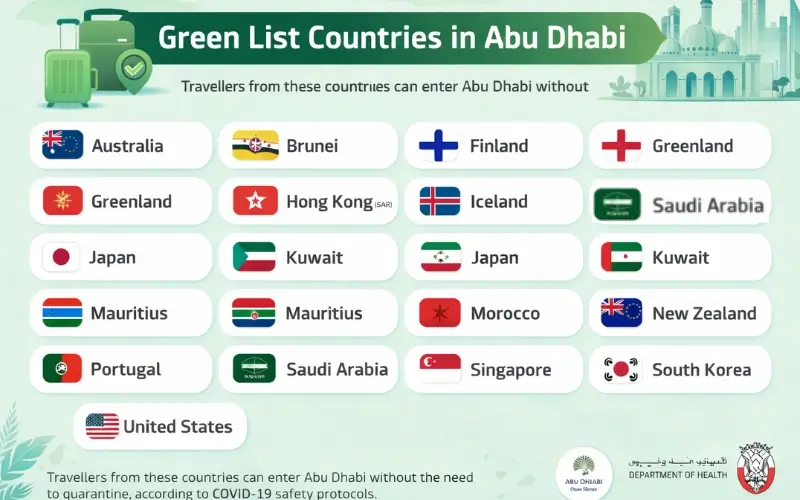
December 26, 2021 — Dropped to 73 countries. The Omicron variant caused a sharp revision. Morocco, Tunisia, Colombia, Belize, and others were removed with very little notice, stranding travelers mid-booking. Japan — despite its cautious pandemic management — was also cut, alongside Bhutan, Brunei, Finland, Greenland, Portugal, Spain, and Uzbekistan.
January 3, 2022 — Minor additions including Algeria, Ireland, and Morocco were re-added.
February 15, 2022 — Final list: 72 countries. Ten days later, the entire system was abolished.
- December 2020 — Launched
- August 2021 — Expanded
- November 2021 — 95 countries
- December 2021 — Omicron reductions
- February 2022 — Abolished
The Countries That Were Never Where People Expected
India is the most significant and least-discussed exclusion. The UAE has over 4.3 million Indian residents — by far the largest expatriate community in the country. India spent most of mid-to-late 2021 off the Green List. The UAE suspended all inbound flights from India on April 24, 2021 when the Delta variant devastated the country. Partial flights resumed on July 21, 2021, but India remained off the list. Indian travelers arriving in Abu Dhabi wore wristbands and quarantined, even if vaccinated — with the added complication that Covaxin wasn’t recognized. India was eventually added toward the end of 2021, but the months it was absent affected hundreds of thousands of families trying to travel in both directions.
Japan had a similar story. One of the world’s most disciplined COVID-management countries, dropped from the list during the Omicron wave purely on case-rate data. No reflection of the country’s overall public health approach — just numbers at a specific moment in time.
Pakistan, Bangladesh, Nigeria, Egypt, and Ethiopia were absent for most of the Green List era. These nations have substantial communities in the UAE, and their ongoing exclusion had real human weight that never got adequate coverage in English-language media.
Abu Dhabi vs. Dubai: Why the Rules Were So Different
The UAE is a federation of seven emirates, and during the pandemic they operated with strikingly different approaches.
Dubai was aggressive about reopening. It prioritized economic recovery, moved faster on lifting restrictions, and kept its airport busier. Its hospitality sector opened earlier and with fewer restrictions.
Abu Dhabi was methodical and strict. Even travel between the two emirates required a negative PCR test taken within 48 hours for a significant part of 2021 — meaning people who lived in Dubai and worked in Abu Dhabi were effectively testing every other day. That inter-emirate testing requirement ended in September 2021.
The contrast was stark enough that Wizz Air physically moved six of its routes from Abu Dhabi International Airport to Dubai International Airport in 2021, explicitly citing Abu Dhabi’s COVID restrictions as the reason. When an airline votes with its fleet, the policy difference becomes undeniable.
Why was Abu Dhabi so much stricter? Partly philosophy — Abu Dhabi’s leadership consistently prioritized caution. Partly economics — the emirate’s oil wealth meant it had less urgent pressure to reopen for tourism revenue. And partly because Abu Dhabi was, in this period, ranked the world’s top pandemic-resilient city by Deep Knowledge Analytics. That ranking was a point of institutional pride, not just a statistic.
The trade-off was real. Abu Dhabi achieved near-100% vaccination coverage and navigated the pandemic without a full lockdown. It also caused genuine hardship for hundreds of thousands of expatriates whose families were trapped on the wrong side of the Green List.
The Day the Green List Ended
February 25, 2022. Abu Dhabi’s Emergency, Crisis and Disasters Committee issued a single announcement that dismantled 14 months of travel architecture in one go.
Quarantine requirements dropped for all international travelers, from every country on earth. The Green List was abolished with no replacement framework. PCR testing on arrival ended for vaccinated travelers. Restaurants returned to 100% capacity. Face mask rules were relaxed.
The reasons were straightforward: Omicron had swept through but proved far less lethal than earlier variants. The UAE had the highest vaccination rate among countries with a population over one million. The epidemiological logic that had sustained the Green List no longer held.
One important distinction that confused people in the weeks after abolition: the Green List and the Al Hosn green pass were two different things. The Green List controlled whether you could enter Abu Dhabi without quarantine. The Al Hosn app’s green pass controlled whether you could enter public spaces within Abu Dhabi — malls, restaurants, cinemas, government buildings. The Al Hosn pass survived the Green List by several months before being phased out in November 2022.
What Abu Dhabi Entry Looks Like Now (2025–2026)
No quarantine. No PCR tests. No vaccine certificates required. No Green List. Entry to Abu Dhabi today is governed by your passport nationality and standard UAE visa policy — nothing else.
GCC nationals (Bahrain, Kuwait, Oman, Qatar, Saudi Arabia) enter with just a passport or national ID. No visa required.
Free 90-day visa on arrival for citizens of most EU countries, Argentina, Brazil, Russia, South Korea, Norway, Switzerland, Serbia, Seychelles, Uruguay, and others.
Free 30-day visa on arrival for travelers from Australia, Canada, the United Kingdom, the United States, Japan, New Zealand, Singapore, Malaysia, China, Hong Kong, and several more.
Advance visa required for nationals of India, Pakistan, Bangladesh, Nigeria, Egypt, the Philippines, Sri Lanka, Nepal, and others. Applications are processed online through the UAE’s ICP (Federal Authority for Identity, Citizenship, Customs and Port Security) portal, through Etihad Airways, or via authorized travel agencies.
Special case worth knowing: Indian passport holders who hold valid residency visas from the US, UK, Australia, Canada, Japan, New Zealand, South Korea, or Singapore can now obtain a 14-day on-arrival visa at Abu Dhabi airport. This was expanded during 2025 UAE visa reforms. It carries a fee, unlike the free versions available to eligible nationalities.
Pakistani nationals gained access to UAE 5-year visas in April 2025 after earlier restrictions were resolved.
Visa run era is over: Since late 2025, most tourist and business visit visas can be extended fully online through the ICP portal without leaving the country. The old practice of a quick flight out to reset your stay is officially gone.
Over 80 nationalities now qualify for visa-on-arrival. The UAE is actively expanding that number each year.
Before You Fly: Practical Checklist
Passport validity: Six months of remaining validity from the date you land — not when you return, not when you booked. More people get caught on this than you’d expect.
Right visa for your nationality: Check icp.gov.ae or visitabudhabi.ae. Your airline’s website is also reliable — carriers are financially responsible for passengers they board who are later denied entry, so they keep this information current.
Return or onward ticket: Immigration can and occasionally does ask for proof you intend to leave. Have it ready regardless of your nationality.
No COVID requirements: Under normal conditions in 2025–2026, there are no health-related entry requirements whatsoever.
Transit rules are separate: Connecting through Abu Dhabi to another destination? You’re subject to your final destination’s rules, not UAE entry rules. Most nationalities can remain airside for short connections without any UAE visa.
Verify within 30 days of travel: UAE policy updates faster than most destinations. Something accurate four months ago may have been superseded.
Why So Many Websites Are Still Getting This Wrong
Search “green list countries Abu Dhabi” today and you’ll find multiple 2021 articles ranking in the top results. Some have fresh titles and recent dates in the URL but unchanged body content. Others have added brief disclaimers while leaving outdated country lists fully visible. A few are confidently telling readers to “confirm your country’s green list status before booking.”
This matters beyond simple inconvenience. A traveler from a country that was never on the old list might assume restrictions still apply to them. Someone from a formerly listed country might assume they have advantages that don’t exist. Both are making decisions based on a system that has been legally non-existent for three years.
The tell: if a website can’t name the exact date the Green List was abolished and explain clearly what replaced it, nothing else on that page deserves your trust.
Don’t Forget To Read It: Mina Rashid Screening Centre
Final Thoughts
The Abu Dhabi Green List was a genuinely significant policy during a specific window of time. It affected millions of people — travelers, expatriates, families — in ways that ranged from mildly inconvenient to deeply painful. The Indian expat separated from a sick parent in Mumbai. The business traveler stranded mid-itinerary when Omicron pulled Morocco off the list without warning. The resident testing every other day just to commute between emirates.
Looking at it from a distance, Abu Dhabi’s approach worked on its own terms. The emirate achieved near-100% vaccination coverage, avoided a full lockdown, maintained its economic foundations, and was twice ranked the world’s most pandemic-resilient city. The Green List was part of that infrastructure — deliberate, data-driven, and expensive in human terms.
But that chapter is closed. Abu Dhabi in 2025 welcomed 26.6 million visitors, its highest number on record. Hotel revenues hit AED 9.1 billion — up 19.5% year-on-year. Indian arrivals surged 22%, leading all international source markets. The city that once turned flights away is now one of the most visited destinations in the world.
The Green List era ended. Abu Dhabi didn’t.
Frequently Asked Questions
Is the Abu Dhabi Green List still active in 2025 or 2026?
No. It was permanently abolished on February 25, 2022. No version of it has been reactivated. Any website telling you to check your country’s green list status for Abu Dhabi travel is providing outdated information.
How many times was the Green List updated?
More than two dozen times across its 14-month lifespan. It updated roughly every two weeks, sometimes more frequently during variant surges. At its peak it covered 95 countries; at its smallest, just 12.
Did the Green List apply to my passport or where I flew from?
Where you flew from — your country of departure, not your passport nationality. A French citizen departing from India during India’s suspension faced the same quarantine rules as an Indian citizen on that same flight. This was one of the most consistently misunderstood elements of the system.
What was the vaccine corridor and how was it different from the Green List?
The vaccine corridor was a separate system allowing fully vaccinated travelers from Bahrain, Greece, Serbia, and Seychelles to enter quarantine-free, even when those countries weren’t on the standard Green List. The condition was that your final vaccine dose was received at least 28 days before travel and was a UAE-approved vaccine. Both systems were abolished together in February 2022.
Was Covaxin (India’s vaccine) recognized by Abu Dhabi during the Green List era?
Not initially. Covaxin was not accepted by UAE authorities for a significant portion of 2021, creating an additional complication for Indian travelers on top of India’s absence from the Green List. This was later resolved, but the overlap period was particularly difficult for Indian expatriates.
What is the difference between the Green List and the Al Hosn green pass?
Completely different systems. The Green List governed international travel into Abu Dhabi — specifically, who could arrive without quarantine. The Al Hosn green pass governed access to public spaces within Abu Dhabi — malls, restaurants, gyms, government buildings — based on your local vaccination and testing status. The Al Hosn pass outlasted the Green List and was phased out in November 2022.
Do I need a COVID test or vaccine certificate to enter Abu Dhabi now?
No. All COVID-related entry requirements have been removed under standard conditions. Entry to Abu Dhabi is now based entirely on nationality and standard UAE visa eligibility.
Why was Abu Dhabi stricter than Dubai during the pandemic?
Several factors: Abu Dhabi’s oil-backed economy meant less immediate tourism-revenue pressure; the emirate’s leadership had a governing philosophy that prioritized caution; and Abu Dhabi was actively building a reputation as a pandemic-resilient city. The Green List was one expression of that approach. Dubai, more dependent on tourism and trade, reopened faster and with fewer restrictions.
What are the current visa-on-arrival rules for Abu Dhabi?
Over 80 nationalities qualify. GCC nationals enter freely with ID. Most EU nationals, Australians, Canadians, British, Americans, Japanese, Chinese, Singaporeans, and others receive free on-arrival visas for 30 or 90 days depending on passport. Nationals of India, Pakistan, Bangladesh, and others need advance visas. Check icp.gov.ae for current, authoritative information.
