
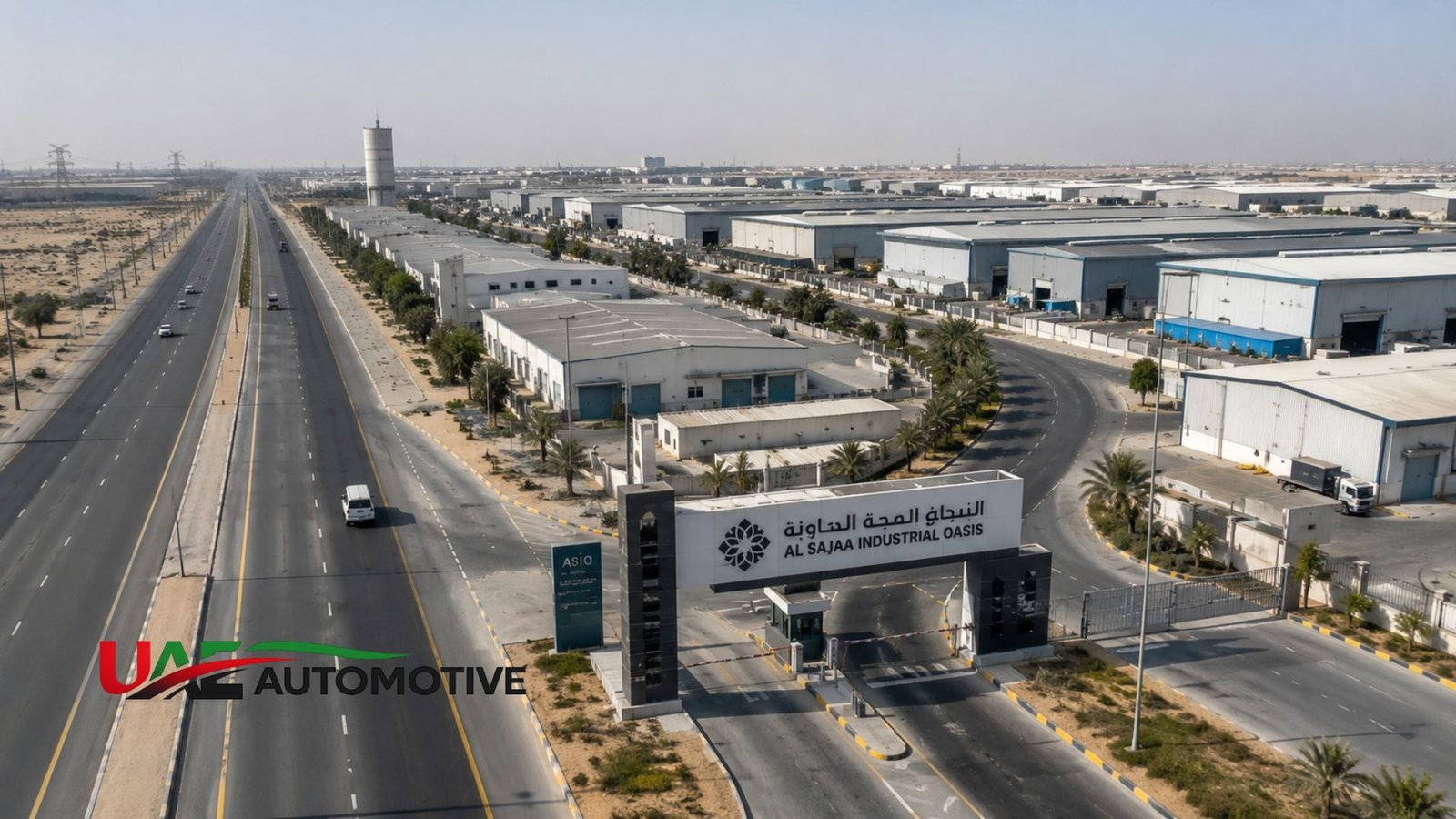
Al Sajaa is an industrial district on the Sharjah–Dhaid highway, next to Emirates Road (E611), built around Al Sajaa Industrial Oasis (ASIO) — a 14-million-square-foot zone developed by Sharjah Asset Management Holding (SAM). Two things almost every article on this keyword misses: Al Sajaa runs on Sharjah’s mainland licensing system (SEDD), not free zone rules, and it’s still an active energy production site — not just a warehouse district. Both facts change how you should plan a lease or business setup here.
We pulled land records, SEDD licensing rules, and Sharjah National Oil Corporation (SNOC) data to put this together, and cross-checked it against a physical visit to the district. Here’s what the top-ranking pages leave out.
- What Is Al Sajaa? (Verified Facts)
- How to Get There
- The Fact That You Don’t Know: Al Sajaa Is a Working Energy Site
- Mainland vs. Free Zone: The Distinction Almost Every Guide Skips
- Al Sajaa Industrial Oasis (ASIO): What's New
- Al Sajaa vs. Hamriyah Free Zone vs. SAIF Zone
- Al Sajaa vs. Dubai Industrial City: The Real Difference
- Getting a Trade License for a Sajaa-Based Business: Step-by-Step
- Major Companies Operating in Al Sajaa
- Infrastructure and Utilities
- Common Mistakes Before Leasing in Al Sajaa
- Pros and Cons
- Future Developments and Expansion Plans
- FAQs
What Is Al Sajaa? (Verified Facts)
Al Sajaa was established in 2008 and sits at coordinates 25°19′50″N 55°38′37″E, roughly 30 kilometres inland from the Sharjah coast. According to Wikipedia‘s entry on Al Sajaa, the area covers 1.30 square kilometres and sits on the Sharjah/Dhaid highway and adjacent to the arterial behind Emirates Road (E611).
| Detail | Verified Figure |
| Established | 2008 |
| Total district area | 1.30 km² |
| ASIO development area | 14 million sq. ft. |
| Number of plots (ASIO) | 353 |
| Plot size range | 13,454 – 53,819 sq. ft. |
| Developer | Sharjah Asset Management Holding (SAM) |
| Licensing authority | SEDD (mainland) |
| Nearby infrastructure | Sharjah International Airport, Al Hamriyah Port |
| Gas plant capacity | 700 MMSCFD |
How to Get There
There’s no metro or rail access — plan around roads only.
- From Dubai: Take Emirates Road (E611) north toward Sharjah/Dhaid — roughly 35–50 minutes depending on traffic.
- From Sharjah city center: Head out on the Sharjah–Dhaid road — 20–30 minutes.
- By bus: Public and private buses serve workers commuting to warehouses and labor camps.
- By private vehicle: The practical default for visitors and business owners. If you need transport sorted before a site visit, checking rental options through uaeautomotive.com ahead of time beats arranging something on the spot.
The Fact That You Don’t Know: Al Sajaa Is a Working Energy Site
Before Al Sajaa was an industrial leasing district, it was Sharjah’s first major gas discovery. Work started on the Sajaa-1 well on 10 May 1980, drilled to a depth of 16,656 feet, marking the discovery of the Sajaa field — one of the largest gas condensate fields in the UAE. Construction of a gas processing plant at Al Sajaa finished by June 1982, alongside a condensate export terminal at Al Hamriyah, and the first cargo of condensate — 500,000 barrels — shipped out on the tanker Amoco Savanah that same year.
This isn’t ancient history sitting behind a museum plaque. The Sajaa Gas Plant currently runs at a capacity of 700 MMSCFD and provides gas transmission and processing services to third parties including Dolphin Gas, Air BP, and Emarat. BP took over the operating role from Amoco in 1999 following a merger, and the asset is now run under Sharjah National Oil Corporation (SNOC).
Why this matters if you’re leasing here: parts of the district sit near active gas infrastructure, and traffic/heavy vehicle patterns around the plant differ from the pure-warehouse sections further out. Anyone comparing plots should ask specifically which zone (industrial leasing vs. energy-adjacent) a listing falls in — most brokers won’t volunteer this distinction.
Mainland vs. Free Zone: The Distinction Almost Every Guide Skips
This is the single biggest gap in existing Al Sajaa content, and it directly affects your licensing cost and trading rights.
Al Sajaa operates under Sharjah’s mainland system, regulated by the Sharjah Economic Development Department (SEDD) — not a free zone authority. A SEDD license is your legal authorization to operate within Sharjah’s mainland market, and unlike free zones, a mainland Sharjah company benefits from significantly lower licensing fees, office rents, and warehousing costs compared to neighboring emirates, while accessing Sharjah’s dedicated industrial zones including Sajaa and Emirates Industrial City. Foreign investors maintain full 100% ownership for over 1,200 commercial and industrial activities without a local sponsor.
This matters practically:
- You can sell directly across the UAE without the local-market restrictions that typically apply to free-zone entities.
- You don’t get free-zone perks like fully virtual offices or zero-corporate-tax guarantees automatically — mainland rules apply.
- Don’t confuse it with Hamriyah Free Zone or SAIF Zone — these are separate legal jurisdictions a few kilometers away, and licensing there follows completely different rules.
Al Sajaa Industrial Oasis (ASIO): What’s New
ASIO is SAM’s masterplanned expansion layered onto the older Sajaa industrial belt. It consists of a total of 353 plots stretching over 14 million square feet, strategically located on Emirates Road (E611), close to Sharjah International Airport and Al Hamriyah Port. The project includes industrial, mixed-use, labor accommodation, and retail components, built on freehold terms for UAE, GCC, and Arab nationals.
What separates ASIO from the older section:
- Standardized plot sizes, so you’re not negotiating leftover irregular land
- Infrastructure and roads built ahead of tenant demand rather than reactively
- A cleaner freehold structure for GCC/Arab investors specifically
What’s Actually on the Ground
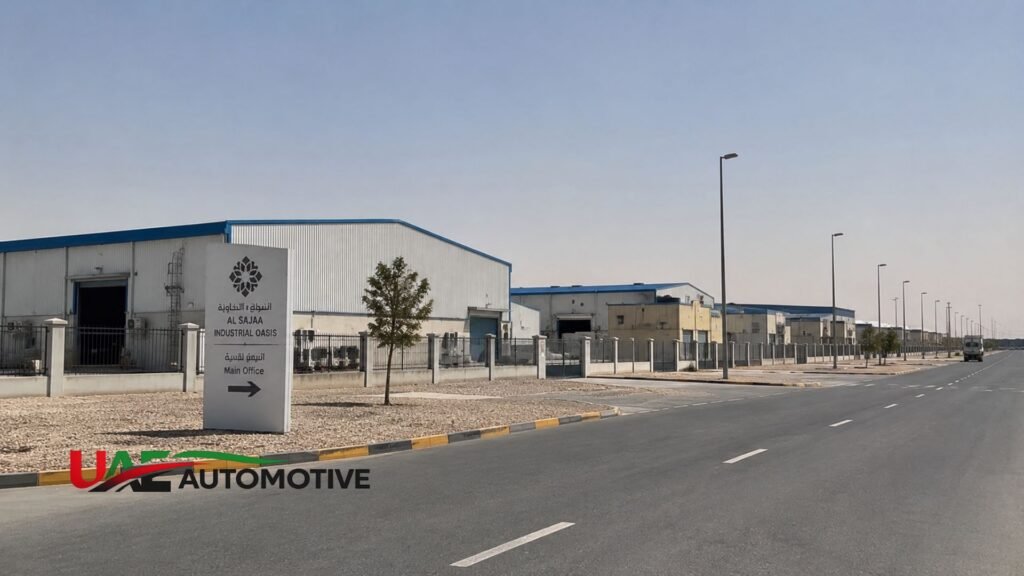
Don’t expect a business park. On a drive-through you’ll pass warehouses, open storage yards, auto workshops, scrap metal dealers, transport company offices, construction material suppliers, and labor accommodation blocks. There’s minimal residential presence and no pedestrian infrastructure connecting clusters — you drive between stops even within the district.
The auto workshop cluster has grown because unit rents (and labor costs) run below city-center garages. If you’re comparing repair or fleet-servicing options across the wider Sharjah–Dubai corridor, cross-check listings against a dedicated directory like uaeautomotive.com before booking a job, since workshop quality inside industrial zones varies more than showroom-based garages.
Rental Costs — And the Real Reason Prices Look Inconsistent Online
If you’ve searched Al Sajaa rents already, you’ve probably noticed wildly different numbers across listing sites. Rental figures published across listing platforms vary enormously because they’re pooling very different unit sizes and unit types under one district label — not because any single figure is wrong. Treat every number below as tied strictly to its size bracket.
| Unit Type | Size Range | Annual Rent (AED) |
| Standard shop | 200 – 700 sq. ft. | 6,000 – 50,000 |
| Small warehouse | 550 – 3,550 sq. ft. | 10,000 – 100,000 |
| Large warehouse | Up to 215,280 sq. ft. | Up to 938,000 |
| Commercial plot | 11,885 – 1,000,000 sq. ft. | Negotiated per lease |
| Industrial leasehold land | 10,000 – 250,000 sq. ft. | 100-year leasehold terms |
Before signing:
- Ask whether the unit is interlocked (shared wall) — these rent cheaper than standalone buildings of equal size.
- Confirm loading/unloading bay dimensions match your truck fleet, not just the total footprint.
- Check proximity to the gas plant zone if noise, heavy-vehicle traffic, or safety buffer distance matters to your operation.
Al Sajaa vs. Hamriyah Free Zone vs. SAIF Zone
These three get confused constantly. Sharjah’s industrial zones — including Hamriyah, Sajaa, and the Sharjah Airport International Free Zone (SAIF Zone) — are major anchors for manufacturing, light industry, and trading businesses, but they’re not interchangeable.
| Factor | Al Sajaa (Mainland) | Hamriyah Free Zone | SAIF Zone |
| Licensing authority | SEDD | Hamriyah FZ Authority | SAIF Zone Authority |
| Ownership | 100% foreign ownership (most activities) | 100% foreign ownership | 100% foreign ownership |
| UAE market access | Direct, no restrictions | Limited without a distributor | Limited without a distributor |
| Office requirement | Physical office required | Virtual office allowed (some licenses) | Virtual office allowed (some licenses) |
| Best fit | Businesses trading UAE-wide | Export-heavy, port-dependent trade | Airport-linked logistics/trade |
Al Sajaa vs. Dubai Industrial City: The Real Difference
These two get compared constantly because they’re both “industrial districts near a highway.” The comparison falls apart once you look at scale, cost, and licensing structure.
The licensing point is the one almost nobody explains correctly. DIC gets marketed as a “free zone” across dozens of consultancy sites, but licenses in Dubai Industrial City are actually issued by the Dubai Department of Economic Development, while other TECOM free zones register companies with the Dubai Development Authority instead. That makes DIC functionally closer to mainland status than a true free zone — the opposite of what most of its own marketing implies. Al Sajaa has no such ambiguity: it’s SEDD mainland, full stop.
Bottom line: DIC wins on scale and per-plot power capacity (useful for heavy manufacturing). Al Sajaa wins on cost per square foot and simplicity of licensing — you’re not untangling a free-zone-vs-mainland debate before you sign anything.
Getting a Trade License for a Sajaa-Based Business: Step-by-Step
- Confirm your activity is mainland-eligible. The Instant License isn’t available for industrial, food, or health-related activities that require ministry approvals — check this before you plan around a fast turnaround.
- Reserve your trade name through the SEDD portal.
- Get initial approval for your specific activity.
- Draft your Memorandum of Association if you’re forming an LLC or multi-partner structure.
- Lease your Sajaa unit and register the tenancy via Tawtheeq, Sharjah’s equivalent of Ejari.
- Register with the Sharjah Chamber of Commerce and Industry.
- Submit final documents to SEDD. Eligible office-based activities can now receive a license within 5 minutes after document submission, following SEDD’s 2024 AI-powered instant issuance system launched with Microsoft — though industrial and food-related activities are excluded from this fast track and follow the standard 4–6 week process.
- Register for tax. All SEDD entities need a Tax Registration Number under current Federal Tax Authority rules.
Renewal cost reality check: the renewal fee for a mainland Sharjah trade license is calculated as 13% of your annual office rent or a minimum of AED 11,000, whichever is higher — so a bigger Sajaa warehouse lease directly increases your annual renewal bill, not just your upfront rent.
Major Companies Operating in Al Sajaa
This is the section most competitor guides skip entirely, listing generic categories (“warehouses, workshops, scrap dealers”) instead of naming who’s actually there. Here’s what’s verifiable:
- Sharjah Cement Company — an integrated cement plant that began operations in 1977, now running more than 4 million tonnes of cement grinding capacity and over 2 million tonnes of clinker production annually. This is one of the oldest continuously operating industrial assets in the district.
- Sharjah National Oil Corporation (SNOC) — operates the Sajaa Gas Plant at 700 MMSCFD capacity, supplying Dolphin Gas, Air BP, and Emarat.
- Gulftainer / Momentum Logistics — Momentum Logistics added an Al Sajaa Depot to its UAE portfolio, and Gulftainer completed the Al Sajaa Access Road project in Sharjah. Gulftainer also runs the Sajaa Dry Port.
- A dense cluster of SME manufacturers and traders registered on business directories under Al Sajaa Industrial addresses, including metal fabrication (New Vision Metal Construction), glass and aluminium contracting (Al Diwan Glass & Aluminium, Bab Toma Aluminium & Glass), steel works (Al Tarfanah Steel Works), and scaffolding rental (Remal Al Sajaa Scaffolding).
The auto-repair and workshop segment is real but fragmented across dozens of small operators rather than a few named brands — if you’re sourcing a workshop here for fleet servicing, cross-check reviews and licensing status through a dedicated directory like uaeautomotive.com rather than relying on a single Google listing, since quality varies more inside industrial zones than at showroom-based garages.
Infrastructure and Utilities
Al Sajaa’s utilities run through the Sharjah Electricity, Water and Gas Authority (SEWA), not a private developer network — this matters because SEWA connection processes and industrial tariffs differ from free-zone-run utility systems.
- Water: The 30.5-km distribution network completed in Al Saja’a in Q1 2026 is part of SEWA’s ongoing effort to expand main transmission lines and replace ageing infrastructure with modern, high-efficiency systems.
- Power: SEWA supplies industrial-grade electricity connections to plots; capacity is negotiated per unit rather than a flat allocation (unlike DIC’s advertised 4MW-per-property standard).
- Gas: SEWA is also the piped natural gas provider for the emirate, separate from the SNOC-operated Sajaa Gas Plant, which processes and exports gas rather than supplying local piped connections.
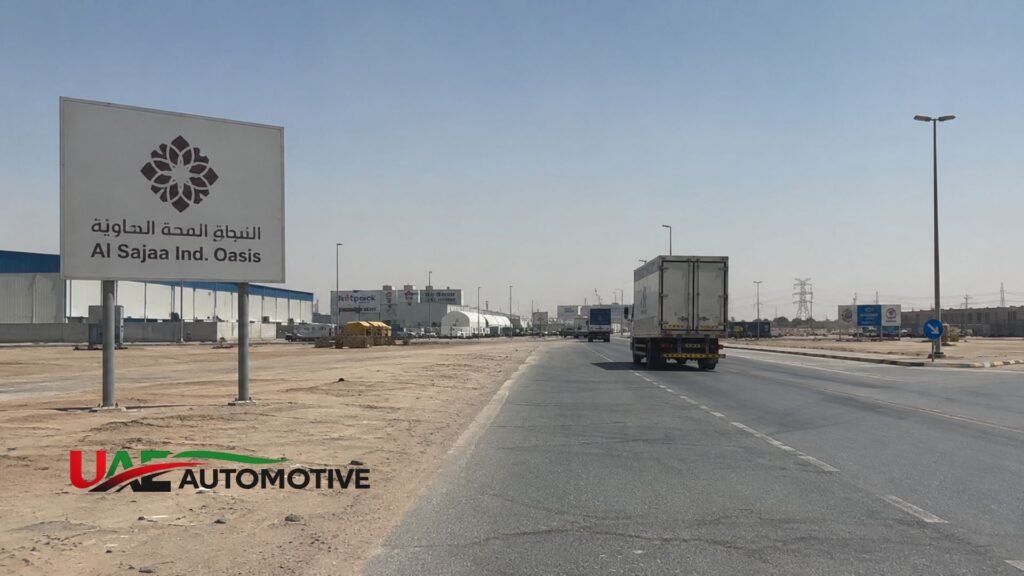
- Roads: Gulftainer’s completed Al Sajaa Access Road project upgraded truck and heavy-vehicle routing directly serving the logistics complex and dry port operations.
- Drainage/stormwater: Newer ASIO plots include stormwater systems built into the infrastructure ahead of tenant occupancy — older sections of Sajaa were retrofitted over time and vary in quality plot to plot.
Practical note: before signing any lease, request the plot’s utility connection certificate from SEWA directly rather than taking a landlord’s word that power/water is “already connected” — this is a common gap between older and newer sections of the district.
Common Mistakes Before Leasing in Al Sajaa
These are the mistakes that actually cause problems, not generic “do your research” advice.
- Assuming Al Sajaa land is freely available for residential subletting. It isn’t, in most cases. Under Sharjah’s Law No. 5 of 2024, low-income workers and labourers are restricted from renting apartments in family-designated areas and must seek accommodation in Industrial Zones or Al Sajaa specifically — meaning labor camp units here are legally regulated, not informal overflow housing. Confirm zoning classification before assuming a unit can house staff.
- Skipping Civil Defence certification. Sharjah Civil Defence has run inspection campaigns across industrial areas, issuing warnings to establishments over improper storage practices, unlicensed housing additions, and use of combustible chemicals or gasses, giving 72 hours to rectify before legal action follows. Confirm your unit has current fire safety and storage compliance before you move inventory in — retrofitting after occupancy costs more and risks a shutdown notice.
- Not verifying municipality zoning approval before signing. The municipality verifies whether your chosen activity is permitted at the selected location as the first step, and this approval must precede tenancy contract registration and lease finalization — signing a lease before this check can leave you holding a contract for an activity the site isn’t zoned for.
- Comparing rent figures without matching unit type. Rental figures published across listing platforms vary enormously because they’re pooling different unit sizes and types under one district label — a AED 20k listing and a AED 900k listing can both be accurate for “Al Sajaa” while describing completely different assets.
- Assuming free-zone benefits apply. Al Sajaa is SEDD mainland. There’s no corporate tax exemption, no virtual office option, and no automatic 100% repatriation guarantee that free-zone marketing sometimes implies — confirm your specific tax and ownership position with SEDD directly rather than assuming free-zone terms carry over.
- Ignoring proximity to the operational gas plant. If your business involves flammable storage, food processing, or anything sensitive to industrial buffer distances, check the plot’s distance from SNOC’s active Sajaa Gas Plant zone before committing — this isn’t flagged on most commercial listings.
Pros and Cons
| Pros | Cons |
| Mainland status = direct UAE-wide trading rights | No metro access |
| Rent well below Dubai industrial zones | Some zones sit near active gas plant infrastructure |
| Freehold for Arab/GCC nationals | Listing prices vary wildly by unit type — hard to compare at a glance |
| Close to airport and Al Hamriyah Port | Almost no residential or walkable amenities |
| 100-year leasehold for non-GCC investors | Industrial/food licenses excluded from SEDD’s instant-issuance system |
Future Developments and Expansion Plans
This is where verified, current information genuinely separates a specialist source from a template one.
Sajaa Logistics Complex (SPCFZA + Gulftainer, active project):
The Sharjah Ports, Customs and Free Zones Authority, in partnership with Gulftainer, is developing the Sajaa Logistics Complex as a fully integrated multimodal platform linking Sharjah’s ports with its airports and industrial zones. The facility spans more than 3 million square feet and is set to achieve a future annual handling capacity exceeding 850,000 twenty-foot equivalent units. Plans include future connectivity to the UAE’s national railway network.
This is a materially bigger claim than the vague “expansion planned” language used on most Al Sajaa guides — it’s a named, capacity-quantified, government-backed logistics project actively under construction as of mid-2026.
Road and utility upgrades (completed, not just planned):
In Q1 2026, SEWA completed a 30.5-kilometre water distribution network in Al Saja’a Industrial Area, along with a 2.3-kilometre transmission line linking Industrial Areas 11, 15, and 17, at a combined cost of roughly AED 5 million. That’s not a future promise — it’s delivered infrastructure.
What to watch, not just what’s promised: rail connectivity mentioned by SPCFZA is directional intent, not a funded timeline as of this writing. Treat it as a medium-term possibility, not a leasing decision factor today.
FAQs
Is Al Sajaa a free zone?
No. Al Sajaa operates under Sharjah’s mainland licensing system rather than as a free zone, meaning registered companies can trade directly across the UAE market without the local-market restrictions that typically apply to free-zone entities.
Is there still active gas production in Al Sajaa?
Yes. The Sajaa Gas Plant runs at a capacity of 700 MMSCFD and supplies third parties including Dolphin Gas, Air BP, and Emarat, operated under SNOC.
Can foreigners own property in Al Sajaa?
Non-Emiratis lease on a 100-year leasehold basis; full freehold is reserved for Arab and GCC nationals under SAM’s ASIO terms.
How fast can I get a trade license for a Sajaa business?
Eligible office-based activities can be issued within 5 minutes after document submission under SEDD’s AI-powered system, but industrial and food-related licenses still follow the standard 4–6 week timeline.
How far is Al Sajaa from Dubai?
Roughly 35–50 minutes by car via Emirates Road (E611), depending on traffic and starting point.
