

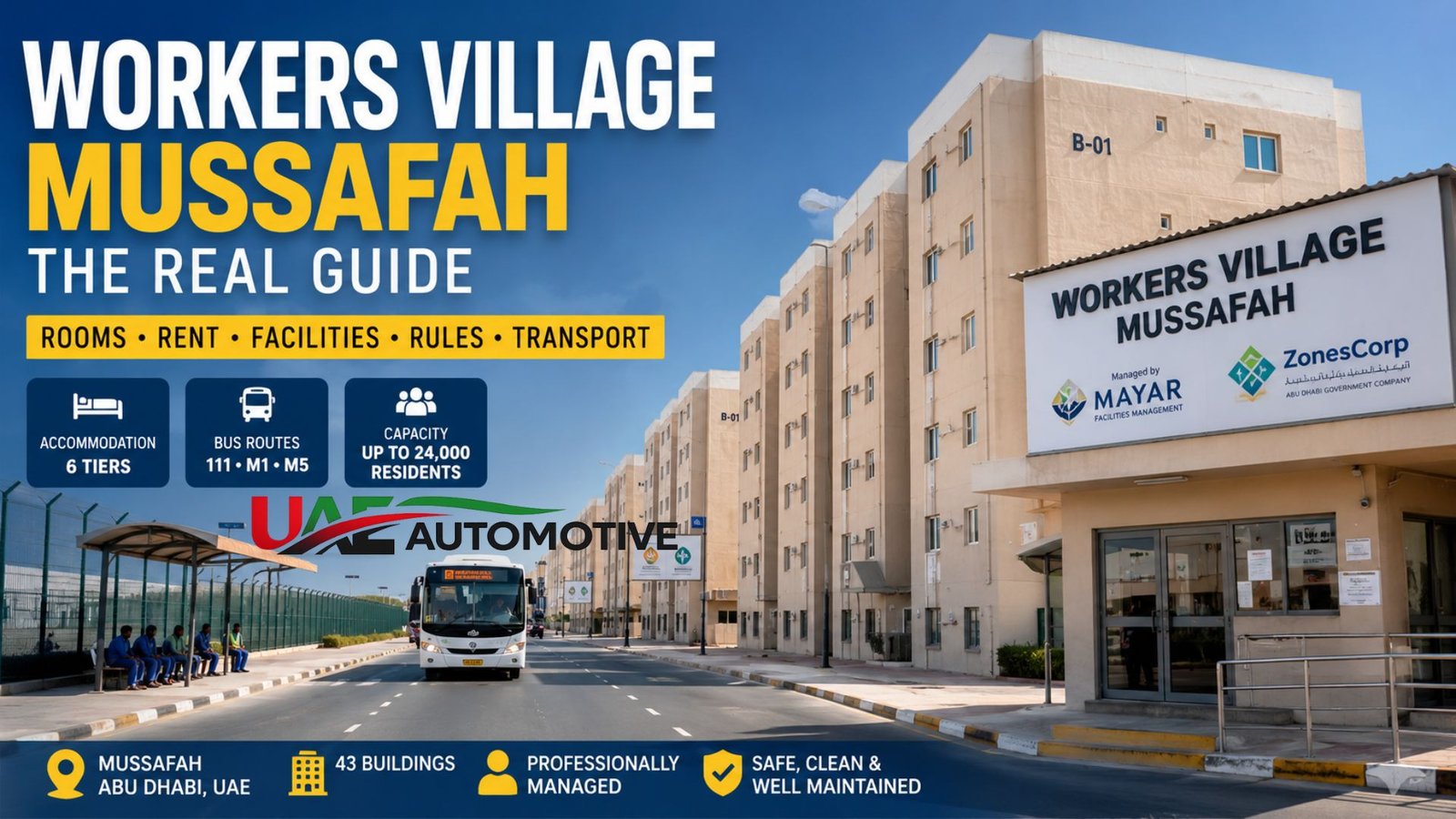
Abu Dhabi’s skyline didn’t build itself. The factories, warehouses, and construction sites of Mussafah keep the emirate running every single day, and behind all of that industrial output is a workforce that needs somewhere to live. Not somewhere luxurious. Somewhere clean, close to work, affordable, and properly managed.
That place is Workers Village Mussafah.
Most articles about this community read like a copy-paste of a brochure. They mention the location, list a few facilities, and stop. This guide doesn’t do that. Whether you’re a worker arriving from abroad and trying to understand what you’re walking into, an HR manager sourcing accommodation for your team, or an employer navigating UAE labour housing laws for the first time, everything you need to know is here.
- Quick Overview
- Understanding Mussafah First
- What Workers Village Mussafah Actually Is
- Location and How to Get There
- The Six Accommodation Tiers
- Facilities: What's Actually There
- What It Costs
- The Regulatory Framework Explained Clearly
- Daily Life Inside the Village: The Honest Picture
- What Employers Need to Know Before Booking
- Nearby Places Worth Knowing
- Mistakes People Commonly Make
- Key Takeaways
- FAQs
Quick Overview
| Detail | Information |
| Location | 12th Street, Musaffah M-24, Abu Dhabi, UAE |
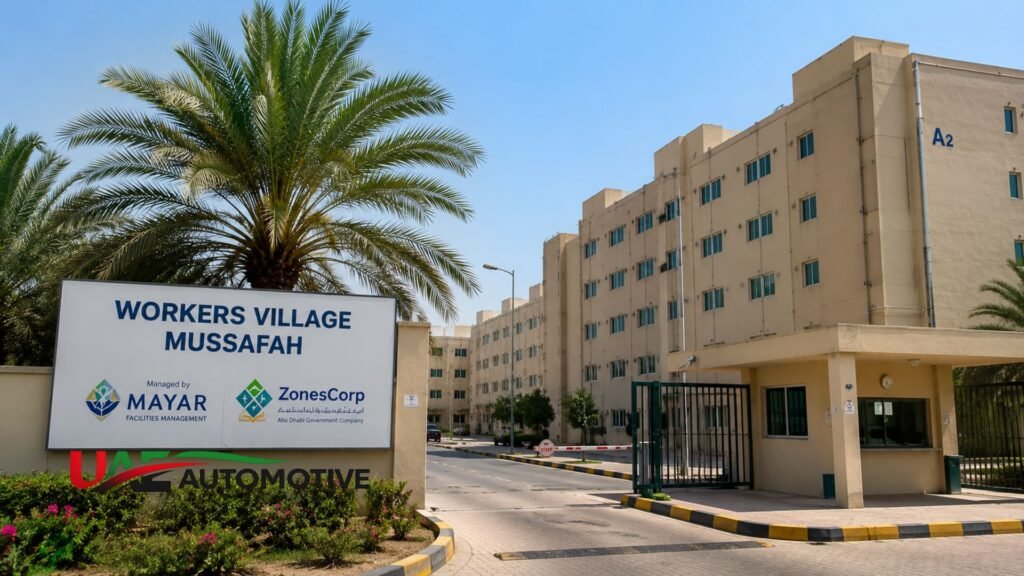
| Managed by | Mayar Facilities Management (in coordination with ZonesCorp) |
| Total Buildings | 43 multi-storey residential blocks |
| Total Capacity | Up to 24,000 residents across companies and categories |
| Nearest Landmark | ICAD I and II, Mussafah Bus Station |
| Room Types | 6 tiers based on employee designation |
| Rent Per Person | AED 250 to AED 500/month (usually employer-paid) |
| What’s Included | Electricity, water, waste collection |
| Key Bus Routes | 111, M1, M5 (TransAD) |
| Healthcare Partner | VPS Healthcare / Lifecare Hospital |
| Regulating Bodies | ZonesCorp, Abu Dhabi Municipality, MOHRE, DMT |
| Contact Number | +971-60-054-6664 |
| Emergency Contacts | 999 (Police), 998 (Ambulance/Fire) |
Understanding Mussafah First
There are other things that have to be known before you can make any sense out of the village.
Mussafah is the main industrial area of Abu Dhabi, which lies south-west of the city. It is not a residential suburb like Khalifa City or Al Reem Island. It is an industrial suburb comprising many factories, logistic centres, warehousing, workshops, building yards, and port facilities spread out over kilometres of industrial area. There are six industrial zones in Mussafah managed by ZonesCorp, the industrial zones authority of the emirate. These zones contribute around 50% of Abu Dhabi’s manufacturing GDP.
There are more than 5,000 companies operating in and around Mussafah. These companies have employees who require housing. The employees could commute from central Abu Dhabi every day; however, it would be costly and draining. The Workers Village Mussafah was established to solve this problem: provide housing close to the workplace.
This one fact alone justifies all the designs of the village.
What Workers Village Mussafah Actually Is
Workers Village Mussafah is one of the finest housing projects in Abu Dhabi, developed in coordination with ZonesCorp management and built upon the Abu Dhabi Government’s vision to develop a highly sustainable community for skilled and productive workers. The village is composed of 43 multiple-floor buildings created to host a workforce of different categories, with a total capacity of 24,000 people from various companies, professional categories, ethnicities, and religions.
That number is worth pausing on. Most competing articles cite 2,500 residents, which refers to one section of the complex. The actual total capacity across the full development is closer to 24,000, making this one of the largest single labour accommodation communities in Abu Dhabi.
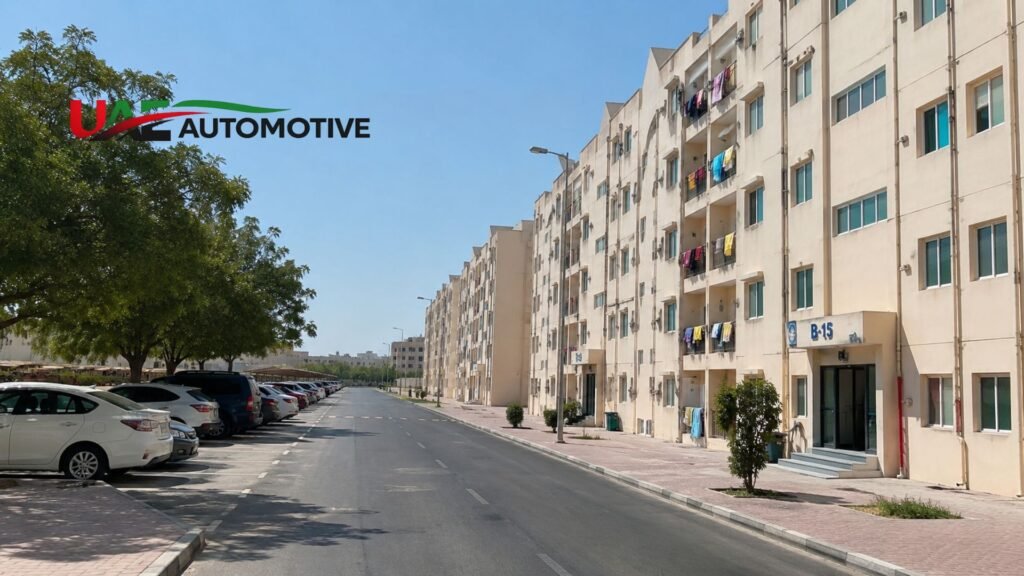
This is not a temporary labour camp. The buildings are permanent, engineered structures built using precast concrete superstructures with insulated external walls, internal walls, staircases, and hollow core slabs. They were designed to last.
The Three Major Village Complexes in the Area
When people say “Workers Village Mussafah,” they’re usually referring to one of three distinct developments:
| Village | Location | Capacity | Operator |
| Workers Village (Main) | 12th St, M-24 Mussafah | 24,000 across companies | Mayar Facilities Management |
| Al Dhafra Workers Village | ICAD III, Mussafah | 7,000 (1,091 rooms) | Al Dhafra Management |
| Al Jimi Worker Village | Musaffah Industrial City | 1,264 rooms across 13 blocks | LEAD Development (delivered 2011, AED 450M project) |
They are separate operations under the same ZonesCorp regulatory umbrella. If someone tells you they live in “Workers Village Mussafah,” confirm which complex they mean before drawing conclusions about facilities or management.
Location and How to Get There
Workers Village sits strategically close to ICAD (Industrial City of Abu Dhabi), where many factories, warehouses, and workshops operate, with proximity to Mussafah Bus Station ensuring easy commuting and quick access to ICAD I and II.
The exact address is: 9G69+6FF, 12th Street, Musaffah M-24, Abu Dhabi, UAE. Google Maps handles it without difficulty.
By Public Bus (TransAD)
Three routes pass directly through the area:
- Bus 111: Connects to central Abu Dhabi
- Bus M1: Mussafah corridor service
- Bus M5: Industrial area circular
The nearest bus stops:
- Street 12 / Village Mall: 4-minute walk
- Street 17 / Workers Village: 5-minute walk
- Ahalia Hospital stop: 13-minute walk
Buses also run to Baniyas and Musaffah Shabiya for residents needing to reach residential commercial areas.
By Taxi or Shared Ride
Taxis are available throughout the zone. Most residents who take taxis share them with colleagues going to the same worksite, which keeps individual costs manageable.
By Company Transport
Most employers with staff at Workers Village Mussafah run their own shuttle service. The administration of Workers Village in Abu Dhabi works with the UAE’s largest transportation companies to ensure safe and punctual transportation of residents to and from work, according to a precise schedule. This is one of the biggest operational advantages of the village: workers don’t need to figure out transport independently.
Google Map Location View
The Six Accommodation Tiers
This is one of the most important things competitors consistently get wrong or leave vague. Workers Village Mussafah does not offer one type of room. The Workers Village in Mussafah has divided its residential units into six categories, and each type of residential unit is based on employees’ designation.
Here’s what each tier looks like in practice:
Tier 1: Manager/Senior Staff Rooms
Private or near-private units with attached bathrooms, private kitchens, wooden cabinets, central A/C, LCD TVs, and internet access. Suitable for administrators and senior management.
Tier 2: Supervisor/Mid-Level Staff Rooms
Shared rooms for 1 to 6 people (22 to 50 sq.m.). Include attached bathrooms, central A/C, TV, storage units, and refrigerators. Cleaner ratio of people to amenities.
Tier 3: Technician Rooms
Shared accommodation for 6 to 10 residents per room (50 to 60 sq.m.). Facilities include centralised ablution areas, multiple shoe racks, lockers, TV, internet access, and communal cooling water stations.
Tier 4: Skilled Worker Rooms
Standard shared dormitory rooms housing 4 to 8 workers. Beds, cupboards, fans or A/C depending on the building, and shared bathroom access on the floor.
Tier 5: General Labour Rooms
Basic shared rooms with the highest occupancy ratio. Core furnishings: bed, storage space, shared facilities. The most affordable category.
Tier 6: Special Category/Single Occupancy
Available within specific buildings for workers whose companies negotiate single-occupancy arrangements. Limited availability, priced accordingly.
The practical point: If you’re an employer, declaring your workers’ designation categories correctly when booking matters. Sending technicians to a general labour room, or vice versa, creates complaints that are entirely avoidable.
Facilities: What’s Actually There
Workers Village Mussafah is more than just accommodation. Facilities include mess halls and cafeterias following HACCP food safety standards, prayer rooms and mosques within the complex, first aid clinics and healthcare partnerships with VPS Healthcare’s Lifecare Hospital, recreational amenities such as football fields, basketball courts, and gyms, supermarkets and Village Mall for daily shopping needs, professional laundry services with daily collection and delivery, and Wi-Fi and IT support for residents to stay connected with family abroad.
Let’s go through each meaningfully.
Food and Catering
Three meals daily are served in Workers Village Mussafah canteens. The food is halal-certified and nutritionally planned for people doing physically demanding work. The important detail most articles skip: the village operates under HACCP (Hazard Analysis and Critical Control Points) food safety standards. This is the same certification framework used in hotel kitchens and commercial food production. It means systematic temperature monitoring, cross-contamination controls, and documented supplier verification. Not a small thing.
Meal bundling with accommodation packages is an option, and for employers housing large teams it eliminates the logistical headache of catering entirely.
Healthcare
There exists a direct link between the village and VPS Healthcare via Lifecare Hospital that is well-equipped among others hospitals in Mussafah including departments such as Neurosciences, Cardiology, Dermatology, ENT, Surgery, ICU, Radiology and Pharmacy. First aid services are available around the clock.
Moreover, the Mussafah area offers the following medical facilities for the villagers:
- NMC Medical Centre
- Phoenix Hospital
- Ahalia Hospital
- Aster Clinic Mussafah
- Mediclinic Al Mussafah
- and LLH Hospital
Internet and Communication
A qualified in-house IT team manages the village’s internet and communication infrastructure. For workers whose most important personal activity is video-calling family back home, reliable connectivity is genuinely significant. It’s not optional; it’s an operational requirement.
Laundry
Daily professional laundry service including collection, cleaning, pressing, and delivery to residents. Saves time and is particularly valued by workers managing shifts.
Recreation
- Football fields and basketball courts
- Gymnasium
- TV rooms and community halls
- Green and communal open areas
- Cultural events and social gatherings during religious holidays
After a physically demanding shift in an industrial zone, structured recreational space has a real effect on mental wellbeing. Workers who have nothing to do outside work hours are more likely to disengage from the community and from their job.
Prayer and Worship
Mosques and dedicated prayer rooms are located within the complex. Religious festivals are sometimes observed within the village to create a feeling of communalism and inclusivity. For Muslim workers, this is a baseline necessity, and its presence inside the village removes the need to travel for prayers.
Security
- 24-hour security guards with CCTV surveillance
- Controlled entry and exit points for visitors
- Fire alarms, extinguishers, and emergency exits in every building
- Complaint management system for residents to report issues without direct confrontation
- Clear conduct rules: no smoking indoors, quiet hours after 10 PM, respect for privacy
What It Costs
This is the question most people actually need answered.
Monthly rent per person: AED 250 to AED 500, depending on room tier and whether A/C is included. In the overwhelming majority of cases, the employer pays this directly. Electricity, water, and waste collection are included in the accommodation cost. No surprise utility bills.
For workers whose company doesn’t cover the cost, the amount is split among roommates, keeping individual contributions low.
Why the Cost Makes Financial Sense for Employers
A comparison puts this in perspective:
| Housing Option | Monthly Cost Per Worker | Utilities Included | Management Included |
| Workers Village Mussafah | AED 250–500 | Yes | Yes |
| Private apartment (shared) | AED 900–1,500+ | Usually not | No |
| Informal labour camp | AED 150–300 | Rarely | No |
The informal camp looks cheapest on the surface. But when employers factor in MOHRE compliance risk, the absence of managed services, and the real cost of running catering and transport separately, the village’s bundled pricing becomes the more economical choice for any team larger than 20 people.
Package Types Available
Operators typically offer three bundling options:
- Accommodation only: Room with utilities
- Accommodation with laundry: Room, utilities, and daily laundry service
- Accommodation with laundry and catering: Full package including three daily HACCP-certified meals
The Regulatory Framework Explained Clearly
This is where most guides either go too deep or skip entirely. Here’s what actually governs Workers Village Mussafah, explained plainly.
ZonesCorp Standards
Workers Village operates within Abu Dhabi’s industrial zones under ZonesCorp authority. ZonesCorp sets the physical and operational standards the village must meet: building specifications, common area management, and service delivery benchmarks.
UAE Federal Labour Law
Establishments with 50 or more workers where the wage of each worker is less than AED 1,500 per month must provide accommodation. Accommodations must be well-lit, air-conditioned, and well-ventilated. Each person should be allocated at least 3 square metres of space.
Workers Village Mussafah exceeds this baseline by design.
MOHRE Approval
The Ministry of Human Resources and Emiratisation maintains an approval framework for worker accommodation. Companies using MOHRE-approved housing reduce their regulatory exposure considerably. Workers Village holds this approval.
Abu Dhabi Municipality and DMT
The Department of Municipalities and Transport enforces local building safety, fire compliance, and residential quality standards through periodic inspections. Non-compliant facilities face penalties. Approved villages like this one maintain compliance as part of their operating model.
What this means for employers in plain terms: using an approved, regulated facility like Workers Village transfers the compliance burden to the operator. You’re not managing fire inspections, hygiene audits, or space allocation checks yourself. The village handles that. Informal housing doesn’t.
Daily Life Inside the Village: The Honest Picture
Most articles stop at the facilities list. Here’s what life in Workers Village Mussafah actually looks like day to day.
The community is genuinely multicultural. Residents arrive primarily from South Asia (India, Pakistan, Bangladesh, Nepal), Southeast Asia (the Philippines, Indonesia), and various African countries. This diversity is reflected in the catering, in the cultural events during Eid and other religious occasions, and in the informal social groups that form between people from the same country or region.
The daily rhythm is predictable: early morning wake-up, company shuttle to worksite, long shift, return to the village, meal in the canteen, recreation or rest, video call home, sleep. Repeat. This is not a community built around leisure or variety. It’s built around function, and most residents understand that completely.
Privacy is limited. Shared rooms mean shared space, shared noise, shared schedules. Workers arriving from environments where personal space is a given will adjust over a few weeks. Workers arriving from similar accommodation setups elsewhere in South Asia or Southeast Asia often find the village’s standards noticeably better than what they were used to.
Friendships form quickly here. Shared routines, shared mealtimes, and shared sport on weekend afternoons create social bonds that outlast any single contract period. Many workers who’ve lived at the village across multiple stints cite the community feel as one of its underrated strengths.
One honest limitation: there are no entertainment venues, malls, or restaurants inside the village itself. For anything beyond daily essentials, residents travel to nearby commercial areas. The Village Mall (Street 12) is a short walk away. Safeer Hypermarket and Al Madina are commonly used for daily shopping. Dalma Mall, Mazyad Mall, and Bawabat Al Sharq are the go-to larger shopping destinations.
Places of worship beyond the village mosque are accessible within Mussafah: multiple mosques including Ahmed Salem Al Mahrami Mosque and Sunni Noor Mosque, plus churches (St. Paul’s, All Saints Anglican, Mar Thoma Church) and the New Gurudwara near 15th Street for the Sikh community.
What Employers Need to Know Before Booking
If you’re an HR manager or employer looking to house staff at Workers Village, a few practical realities matter before you sign anything.
Booking Is Company-Led
Individual workers cannot independently book accommodation here. The process runs through company HR, which holds a contract with village management for a block of beds or rooms. Workers are then assigned based on their designation category. Make sure your designation data is accurate before booking.
Contract Terms
Contracts run annually in most cases. Post-dated cheques are standard UAE commercial practice here. Always read the terms on early termination and workforce transfers. Mid-contract staff changes are common in industrial sectors, and losing months of pre-paid accommodation because of a project reshuffle is a real and avoidable cost.
Book Early During Peak Periods
Capacity tightens during periods of high construction or industrial activity. Employers planning large workforce deployments in Mussafah should secure accommodation well before staff visas are issued, not after.
Don’t Ignore Designation Tiers
Assigning a senior technician to a general labour room because “it’s all the same building” leads directly to HR complaints. The six-tier system exists for a reason. Use it correctly.
Nearby Places Worth Knowing
Beyond the village itself, Mussafah offers a functional ecosystem for daily life.
Healthcare
- Lifecare Hospital (VPS Healthcare): Village’s direct partner
- Ahalia Hospital: 13 minutes walk from the village
- NMC Medical Centre, LLH Hospital, Mediclinic Al Mussafah, Aster Clinic Mussafah
Shopping
- Village Mall: 4-minute walk (Street 12)
- Safeer Hypermarket, Al Madina Supermarket: daily essentials
- Dalma Mall: larger retail and dining, accessible by bus
Distances from Workers Village to Key Abu Dhabi Landmarks
- Abu Dhabi Airport: approximately 20 km (17 minutes by car)
- Sheikh Zayed Grand Mosque: approximately 15 km (25 minutes)
- Yas Island: approximately 30 km (25-30 minutes)
- Abu Dhabi Corniche: approximately 4.6 km (6 minutes)
Mistakes People Commonly Make
Assuming all buildings are the same standard. They’re not. The six-tier designation system means a manager’s unit and a general labour room are in different buildings with different amenities. Understand which tier your staff qualifies for.
Not clarifying what the rent includes. “AED 300 per person” means nothing without knowing whether electricity, water, laundry, and meals are bundled. Always confirm the exact package.
Leaving accommodation booking until after visa processing. Capacity fills up. Several employers have had workers arrive in Abu Dhabi with valid visas and no confirmed bed because they assumed availability. Book first.
Thinking HACCP catering is a luxury detail. For employers housing workers in physically demanding industrial roles, food quality and safety directly affect productivity and health. HACCP certification isn’t a marketing line, it’s an operational standard that prevents food-related illness in a community of thousands.
Ignoring the complaint system. Workers Village has a formal complaint box mechanism. Residents can raise issues with management directly. Employers who assume their workers have no formal channels inside the village are wrong, and finding out through a MOHRE escalation is a worse way to learn it.
Key Takeaways
- Workers Village Mussafah is a professionally managed and government regulated labour housing community within the largest industrial area of Abu Dhabi.
- The entire complex has the capacity of housing up to 24,000 workers in 43 multi-storey building units, not 2,500 workers mentioned in most articles about the facility.
- Housing is provided for employees on the basis of their job title or designation, ranging from general labourers in rooms to manager level private facilities.
- The cost is around AED 250 – 500 per month per individual and includes utilities, usually sponsored by employers.
- There are also other services provided by the community including HACCP certified catering, healthcare services provided through cooperation with VPS/Lifecare Hospital, professional laundry services, managed IT services, round-the-clock security, and shuttle transport services.
- Regulation of this housing includes such agencies as ZonesCorp, Abu Dhabi Municipality, MOHRE and UAE labour laws. The use of approved facility automatically means that compliance shifts to the provider.
- The entire community is truly multicultural, well-run and functional.
FAQs
Can an individual worker book accommodation at Workers Village without an employer?
Generally no. The village operates on a company-contract model. Accommodation is allocated through employer HR, and individual walk-in bookings are not the standard arrangement. Workers whose employers don’t have a village contract would need to explore other Mussafah accommodation options, such as private staff apartments in the Shabiya area.
Are families allowed to stay in Workers Village Mussafah?
The main village is designed for single workers and shared workforce accommodation. It’s not configured for family living. Workers with families in the UAE typically arrange separate housing in Abu Dhabi’s residential areas, with Mussafah Shabiya being the most practical nearby option for budget-conscious families.
What if I have a complaint about my room or living conditions?
Workers Village operates a formal complaint box system. Residents can submit complaints without direct confrontation with management. For employment-related grievances beyond accommodation, MOHRE’s dispute resolution channels are available independently of the village.
Does Workers Village Mussafah provide transportation to worksites?
The village administration works with major UAE transportation companies to coordinate scheduled shuttle services. Many individual companies also run their own dedicated buses for their staff. Confirm your company’s arrangement before arrival to avoid any gap in the first days.
Is the food at Workers Village suitable for vegetarians or different dietary needs?
Catering is halal-certified as a baseline. Vegetarian options are typically available given the significant South Asian resident population. For specific allergies or specialised dietary needs beyond this, it’s worth confirming directly with the village catering management rather than assuming.
How does Workers Village compare to other Abu Dhabi labour accommodation options?
Other well-regarded communities for staff accommodation in Abu Dhabi include Saadiyat Accommodation Village, Labotel Workers Village, and Al Raha Village. Workers Village Mussafah’s primary advantage is its location directly within Mussafah’s industrial zone. For workers employed in ICAD or Mussafah factories, the commute advantage alone justifies the choice over alternatives elsewhere in the emirate.
What is the difference between the main Workers Village and Al Dhafra Workers Village?
Both are purpose-built labour accommodation complexes within the Mussafah zone, but they’re separate developments. The main village (Mayar-operated) has 43 buildings and capacity for up to 24,000 residents across all companies. Al Dhafra Workers Village is located in ICAD III with 12 blocks, 1,091 rooms, and capacity for 7,000 workers, operated with a distinct “Village-Mates” community ethos. Both fall under ZonesCorp jurisdiction.
Is Mussafah a free zone?
Not all of it. The broader Mussafah district is an industrial area, but the Industrial City of Abu Dhabi (ICAD) within Mussafah operates under free zone regulations. This distinction matters for companies considering whether their operations qualify for free zone incentives and what accommodation approval framework applies to their workers.
