

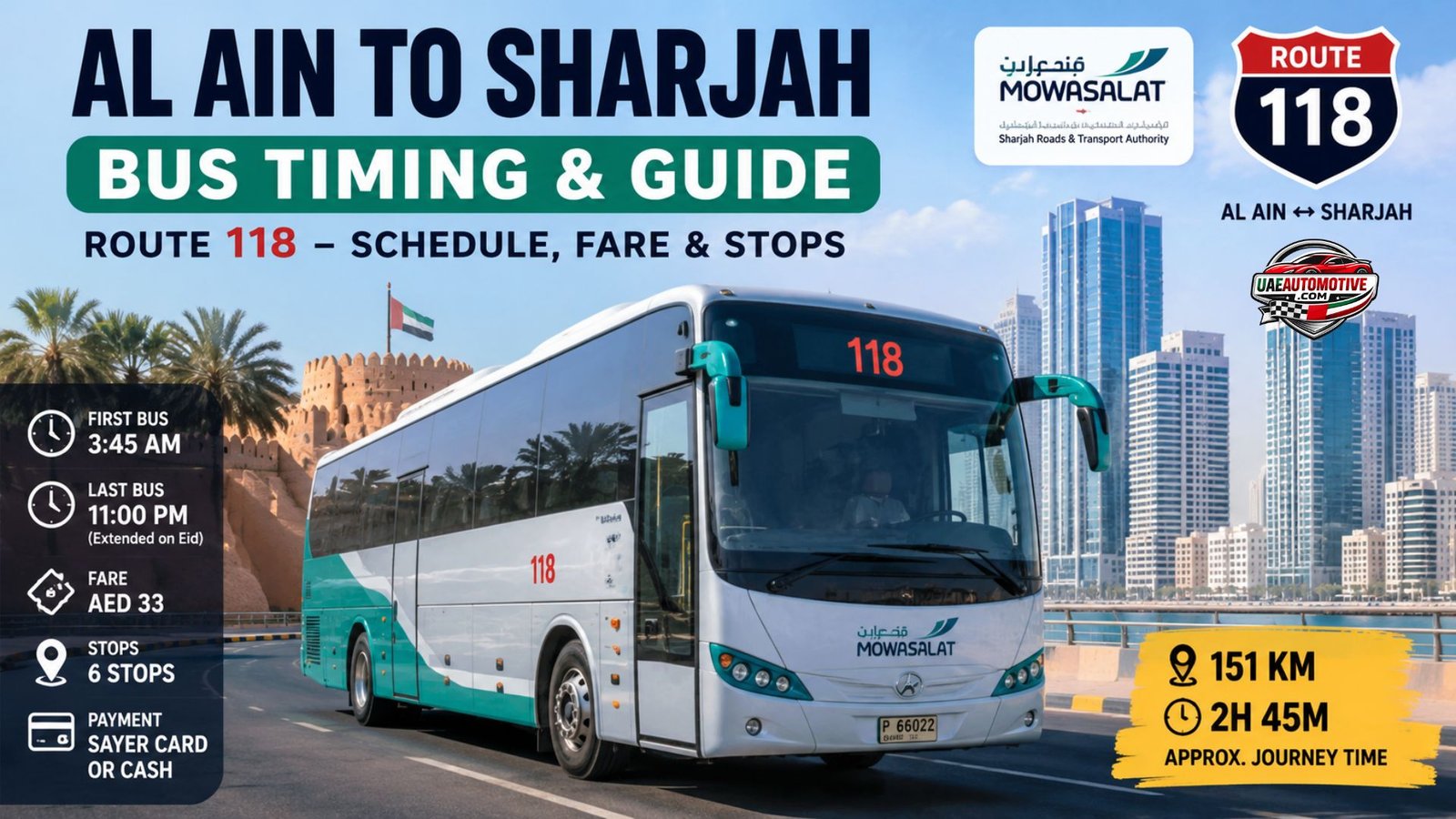
Missing a bus by four minutes in 40-degree heat has a way of ruining an otherwise good day. That’s usually how people end up searching for Al Ain to Sharjah bus timing in the first place — not out of idle curiosity, but because they’re standing at a terminal wondering whether the next departure is ten minutes away or seventy.
The route in question is Bus 118, run by the Sharjah Roads and Transport Authority (SRTA) under its Mowasalat public transport brand. It’s the only direct bus link between Al Ain — the Garden City that technically sits inside Abu Dhabi emirate — and Sharjah’s Al Jubail Bus Station on the other side of the country. No transfers, no juggling two separate tickets, no guessing which connecting service to catch. Just one bus, one fare, and a fairly long ride across the desert interior.
What makes this route confusing isn’t the schedule itself — it’s actually quite consistent once you know the pattern. The confusion comes from outdated listicles repeating the same five facts without checking whether anything has changed, and from a couple of genuinely persistent myths about payment cards that trip up travelers at the ticket counter.
This guide brings together the timetable, the real distance and journey time, every stop along the way, what you’ll actually pay, how schedules shift during Ramadan and Eid, and a few practical details rarely covered elsewhere — including how to track the bus in real time before you’ve even left the house.
Let’s start with the numbers, then work through everything behind them.
Have A Look On It: Abu Dhabi to Sharjah Bus Timings Route 117
- Quick Overview: Al Ain to Sharjah Bus 118
- A Sharjah Bus Running Through Abu Dhabi Territory
- The Full Timetable: How Often the 118 Actually Runs
- Holiday Schedules: What Changes During Ramadan and Eid
- The Six Stops Along the Way
- What You'll Actually Pay (and the Card Mistake Almost Everyone Makes)
- Tracking the Bus Before You Even Leave the House
- Booking, Boarding, and Avoiding an Awkward Wait
- What the Ride Is Actually Like
- Common Mistakes Travelers Make on This Route
- If the Bus Doesn't Suit Your Schedule
- Key Takeaways
- Al Ain to Sharjah Bus Timing FAQs
Quick Overview: Al Ain to Sharjah Bus 118
| Detail | Information |
| Bus number | 118 |
| Operator | Sharjah Roads and Transport Authority (SRTA) / Mowasalat |
| Route | Al Ain Central Bus Station ↔ Al Jubail Bus Station, Sharjah |
| First departure | 3:45 AM |
| Last departure | 11:00 PM (extended during Eid; see below) |
| Frequency, 3:45 AM–6:00 AM | Every 45 minutes |
| Frequency, 6:00 AM–11:00 PM | Every 60 minutes |
| Journey duration | Roughly 2 hours 45 minutes |
| Distance | Roughly 151 km |
| One-way fare | AED 33 |
| Total stops | 6 |
| Payment accepted | Cash or Sayer card (not Nol) |
| Operates | Daily, including weekends and public holidays |
| Live tracking | RIHLATI app, or SMS to 2272 |
| Customer service | 600 52 52 52 |
Keep this table as your quick reference. Everything below fills in the reasoning, the exceptions, and a few things this table simply can’t capture.
A Sharjah Bus Running Through Abu Dhabi Territory
Here’s something most guides skip entirely, and it’s genuinely useful context. Al Ain belongs to Abu Dhabi emirate. Sharjah is a separate emirate altogether. Yet the bus connecting the two is run by Sharjah’s transport authority, not Abu Dhabi’s.
That’s not an error — it’s how the UAE’s intercity network has worked for years. Individual emirates frequently operate cross-border routes through arrangements with their neighbors, and SRTA has long run services reaching into both Abu Dhabi territory (this 118 route, plus the sister Route 117 to Abu Dhabi city) and Dubai’s network. Both lines were suspended during the pandemic and formally reinstated by SRTA in September 2021, and they’ve run on a stable schedule since.
Why mention this at all? Because the Al Ain Central Bus Station itself isn’t an SRTA-branded facility, which occasionally confuses first-time riders about which counter actually sells the 118 ticket. If in doubt, just ask for “the Sharjah bus, 118.” Staff are used to the question.
The Full Timetable: How Often the 118 Actually Runs
The frequency pattern is simple once it clicks, but the early morning window throws people off because it doesn’t match the rest of the day.
Early Morning Window (3:45 AM – 6:00 AM)
Buses run every 45 minutes here rather than hourly — a deliberate choice to absorb early shift workers, delivery staff, and laborers who need to cross emirates before sunrise traffic builds.
| Approximate Departure |
| 3:45 AM |
| 4:30 AM |
| 5:15 AM |
| 6:00 AM |
Daytime and Evening Window (6:00 AM – 11:00 PM)
From here it settles into a predictable hourly rhythm:
| Approximate Departures |
| 7:00 AM, 8:00 AM, 9:00 AM, 10:00 AM, 11:00 AM |
| 12:00 PM, 1:00 PM, 2:00 PM, 3:00 PM, 4:00 PM |
| 5:00 PM, 6:00 PM, 7:00 PM, 8:00 PM, 9:00 PM, 10:00 PM |
| 11:00 PM (final regular departure) |
A caveat worth taking seriously: these are indicative times built from the published frequency rule, not a live, minute-perfect feed. If a 20-minute miscalculation would genuinely wreck your plans, confirm same-day timing through the RIHLATI app or the SRTA hotline before committing.
Google Map Route View
Holiday Schedules: What Changes During Ramadan and Eid
This is the part almost every other guide leaves out entirely, and it’s the one most likely to catch travelers off guard.
During Ramadan, SRTA’s intercity services keep their normal first and last departure times, but frequency on busy corridors can be adjusted to match demand. During Eid, the change is far bigger. For Eid Al Fitr 2026, SRTA ran a four-day enhanced operation (March 19–22) deploying 155 buses across 4,600 intercity trips into neighboring emirates, with peak-hour intervals on intercity routes cut to just five minutes — a sharp jump from the standard 45-minute gap. Al Jubail Bus Station itself stayed open from 3:45 AM until 1:30 AM the following day throughout the holiday to handle the surge of family visits.
The practical takeaway: if you’re traveling around a major holiday, don’t assume the regular timetable above applies unchanged. Waits are usually shorter, not longer, but the station hours and last-departure cutoff genuinely shift. A quick check of SRTA’s announcements or the RIHLATI app in the days before Eid or Ramadan saves any last-minute guesswork.
The Six Stops Along the Way
Bus 118 isn’t a non-stop express. It makes six stops total, and knowing them helps if you’re not boarding from the very first or last point.
- Al Ain Central Bus Station — the starting terminal, with ticket counters, seating, and small cafés for early arrivals.
- King Faisal Street — a pickup point for nearby residents rather than a major terminal.
- Ittihad Safeer Mall — useful if you’re combining the trip with shopping or need a last bathroom break before the long stretch.
- Ittihad Park — a quieter stop, mostly used by locals living nearby.
- Al Wahda Street — one of the last pickup points before the bus enters Sharjah’s urban grid.
- Al Jubail Bus Station, Sharjah — the final stop, and a major hub connecting onward to local Sharjah routes and several Dubai-bound services.
Boarding partway through the route — say, at Ittihad Safeer Mall instead of the starting terminal — works out cheaper than the full AED 33 fare, since pricing is calculated on the distance actually traveled. The driver or onboard reader handles this automatically.
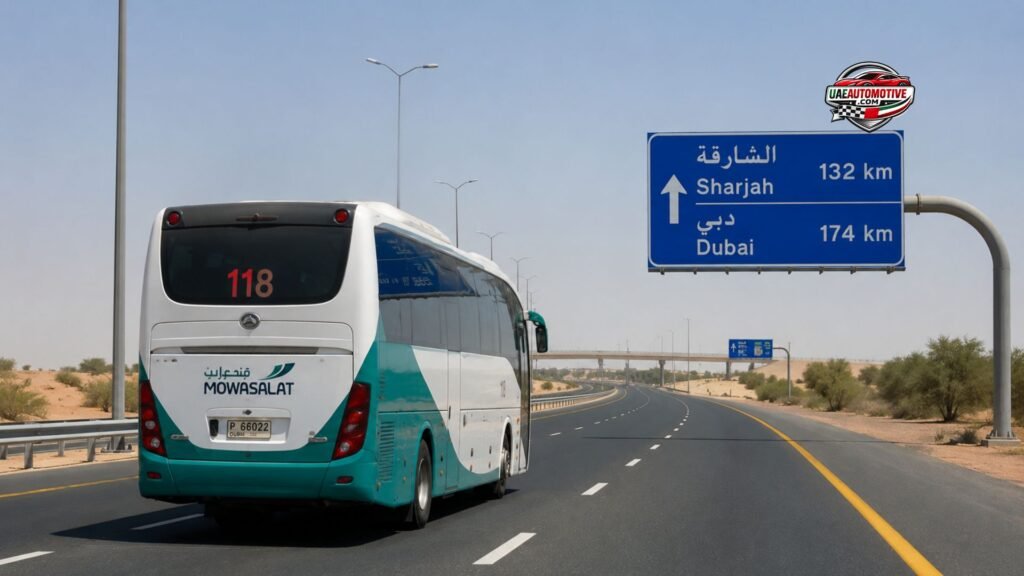
The route itself runs largely via the E66 (Dubai–Al Ain Road) connecting into the E611 Emirates Road bypass, which threads through Al Dhaid before reaching Sharjah — a path that avoids cutting through central Dubai entirely, which is part of why the journey stays fairly predictable for timing despite covering 151 km of open highway.
What You’ll Actually Pay (and the Card Mistake Almost Everyone Makes)
The fare is AED 33 one-way for the full route, a figure that’s held steady across recent checks well into 2026. It’s genuinely one of the cheapest ways to cover 151 km anywhere in the UAE — cheaper than fuel alone for most private cars, and a fraction of a taxi fare for the same distance.
Here’s the part worth slowing down for. A surprising number of articles tell readers to use a Nol card on this bus. That’s incorrect, and it’s an easy mistake if you’ve only ever ridden Dubai’s public transport. Nol is Dubai RTA’s card. Sharjah runs an entirely separate cashless system called the Sayer card, issued and managed by SRTA through Mowasalat. The two are not interchangeable — a Nol card simply won’t register on a Sharjah bus reader, and a Sayer card won’t work in Dubai.
| Payment Method | How It Works | Notes |
| Cash | Pay the driver directly when boarding | Simplest for occasional or one-time riders |
| Sayer card (Blue/Discount) | Tap the onboard reader; fare deducts automatically | Offers a discount over cash; bought and topped up onboard from the driver |
| Sayer card (Grey/Subscription) | Flat AED 225 monthly fee, unlimited rides | Built for daily commuters, not occasional trips |
| Sayer Exempt Card (White) | Free travel for eligible passengers | UAE residents with disabilities, elderly residents, or registered social-assistance beneficiaries |
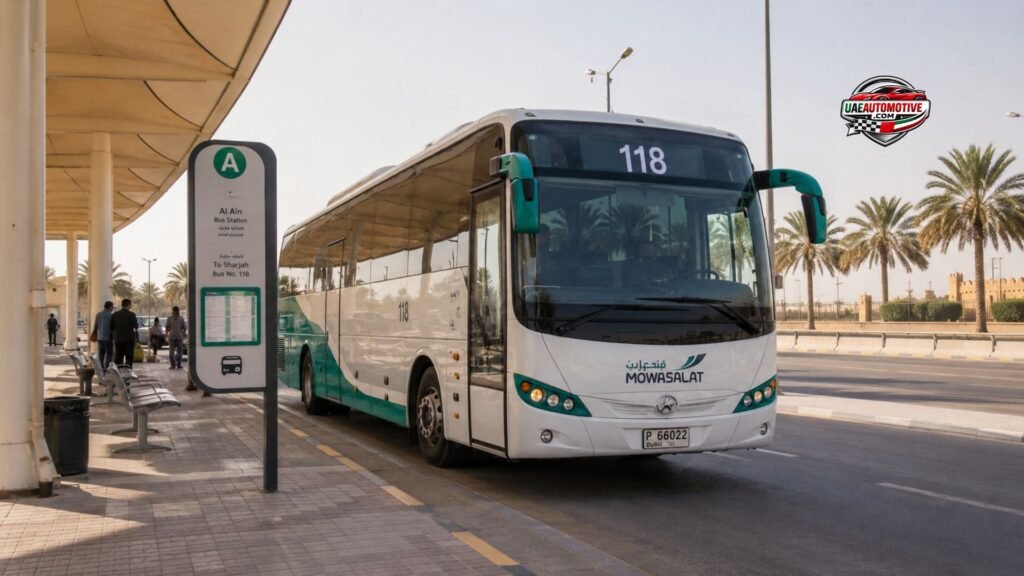
A new Sayer card costs about AED 5 to issue, and there’s no reliable online top-up yet — recharges happen onboard, in cash, handed directly to the driver, who prints a receipt showing your updated balance. For tourists or single trips, paying cash is honestly the least complicated option. Save the Sayer card for if you’ll be riding Sharjah buses regularly.
Tracking the Bus Before You Even Leave the House
This is a detail almost no other guide mentions, and it genuinely solves the original problem — not knowing whether you’ve missed the bus by four minutes or have plenty of time to spare.
SRTA’s RIHLATI service uses GPS and GSM tracking to give live arrival estimates, available through the Mowasalat app or website. There’s also a low-tech backup that works on any phone: send your bus stop number as a text to 2272, and you’ll get the next arrival time back by SMS (AED 1 per message). It’s built primarily around Sharjah’s numbered city bus stops, so it’s most reliable for the Al Jubail end of the journey — for the Al Ain side, the SRTA hotline (600 52 52 52) or the app itself is the more dependable source.
Booking, Boarding, and Avoiding an Awkward Wait
There’s no formal seat-reservation system for Route 118 — you can’t lock in a specific seat days ahead the way you might on a long-haul coach elsewhere. Tickets are sold at the counter or directly to the driver, and seating is first-come, first-served.
A few habits make this smoother:
- Arrive 10–15 minutes before your intended departure, especially in the early morning window when buses run more often but also fill faster with shift workers.
- Carry small cash denominations. Drivers handling a steady stream of passengers don’t always have change for large notes.
- Confirm same-day timing if you’re traveling around Ramadan, Eid, or right after a public holiday, since those are exactly the windows where the standard timetable doesn’t fully apply.
- Ask staff at Al Ain Central Bus Station about luggage space if you’re carrying anything beyond a single bag — most intercity buses on this route accommodate larger items, but it’s worth confirming before boarding rather than during.
What the Ride Is Actually Like
The 2 hour 45 minute journey runs largely through open desert highway, so don’t expect scenic stops — it’s functional travel, not a tour. Buses are air-conditioned, which matters more than it sounds given the trip length and the climate, with standard intercity coach seating and designated priority seats near the front for women, children, and passengers with mobility needs. Most SRTA intercity buses also offer onboard WiFi, though signal strength across the more remote desert stretches can be patchy.
There are no scheduled rest stops built into the timetable. It’s a direct run between terminals, so sort out food, water, and bathroom needs before boarding rather than counting on a midway break.
Common Mistakes Travelers Make on This Route
- Assuming a Nol card works. It doesn’t. Bring cash if you’re unsure.
- Missing the early morning frequency change. Riders expecting hourly service at 4:30 AM sometimes miss a bus that actually exists.
- Boarding with strong-smelling food. SRTA buses generally discourage this out of consideration for other passengers; snacks and bottled water are fine.
- Ignoring Ramadan or Eid schedule shifts. The standard timetable simply doesn’t apply during these windows — check before you travel.
- Treating 2 hours 45 minutes as a hard guarantee. That estimate assumes normal traffic. Add a buffer if you’re connecting to a flight, an exam, or any fixed appointment in Sharjah.
If the Bus Doesn’t Suit Your Schedule
| Option | Approximate Cost | Best For |
| Bus 118 | AED 33 | Budget travel, flexible timing, solo travelers |
| Private taxi | Significantly higher, metered | Door-to-door convenience, time-sensitive trips |
| Ride-hailing apps (Careem, Uber) | Mid-range, demand-based | Flexible pickup without owning a vehicle |
| Connecting via Dubai (E306 etc.) | Similar to direct fare, plus transfer time | Backup option if your timing clashes with the direct 118 |
| Self-driving | Fuel + Salik tolls | Groups, or anyone needing a vehicle at the destination |
For most solo travelers without urgent time pressure, the bus remains the most economical option by a wide margin.
Key Takeaways
- Bus 118 is the only direct service between Al Ain and Sharjah, run by SRTA, operating daily from 3:45 AM to 11:00 PM.
- Frequency is every 45 minutes before 6:00 AM, then hourly through to the final departure.
- The trip covers roughly 151 km in about 2 hours 45 minutes for a flat AED 33 fare.
- During Eid, SRTA significantly boosts capacity and extends station hours — don’t assume the regular schedule applies.
- Sayer card, not Nol, is the correct payment card here — cash works just as well for occasional riders.
- RIHLATI (app or SMS to 2272) gives live arrival estimates, mostly reliable on the Sharjah end of the route.
- There are six stops total, and boarding partway reduces your fare accordingly.
Don’t Forget To Read It: X25 Bus Timetable
Al Ain to Sharjah Bus Timing FAQs
Is the 118 bus the only direct route between Al Ain and Sharjah?
Yes. It’s the sole direct service connecting the two cities without a transfer. An indirect alternative exists through Dubai’s Al Ghubaiba terminal, but it takes longer.
Can tourists use this bus without a Sayer card?
Yes — paying cash directly to the driver works fine for a single trip. The Sayer card mainly benefits frequent, repeat riders through discounted fares and its subscription option.
Does the schedule change during Ramadan or Eid?
Yes. First and last departures generally hold steady through Ramadan, but Eid sees a major capacity boost — more buses, shorter peak-hour intervals, and extended station hours at Al Jubail.
How can I check if the bus is running late?
Use the RIHLATI app for live GPS-based tracking, or text your bus stop number to 2272 for an SMS arrival estimate (AED 1 per message). For the Al Ain side specifically, calling SRTA’s hotline is more reliable.
How early should I arrive before departure?
Around 10–15 minutes is usually enough, but arrive earlier during the 3:45 AM–6:00 AM window, on weekends, or around any holiday.
Is there WiFi or air conditioning on board?
Most SRTA intercity buses, including this route, are air-conditioned and typically offer WiFi, though connectivity can weaken across the more remote desert stretches.
What happens if I miss my scheduled bus?
Nothing dramatic — just wait for the next one. That’s a 45-minute wait at most during the early morning window, or roughly an hour during the day.
Is the bus cheaper than driving yourself?
For a single traveler, almost always — once fuel and Salik toll costs are factored in. For groups of three or more splitting fuel costs, a private vehicle can occasionally come out even, though it loses the convenience of someone else doing the driving.
