
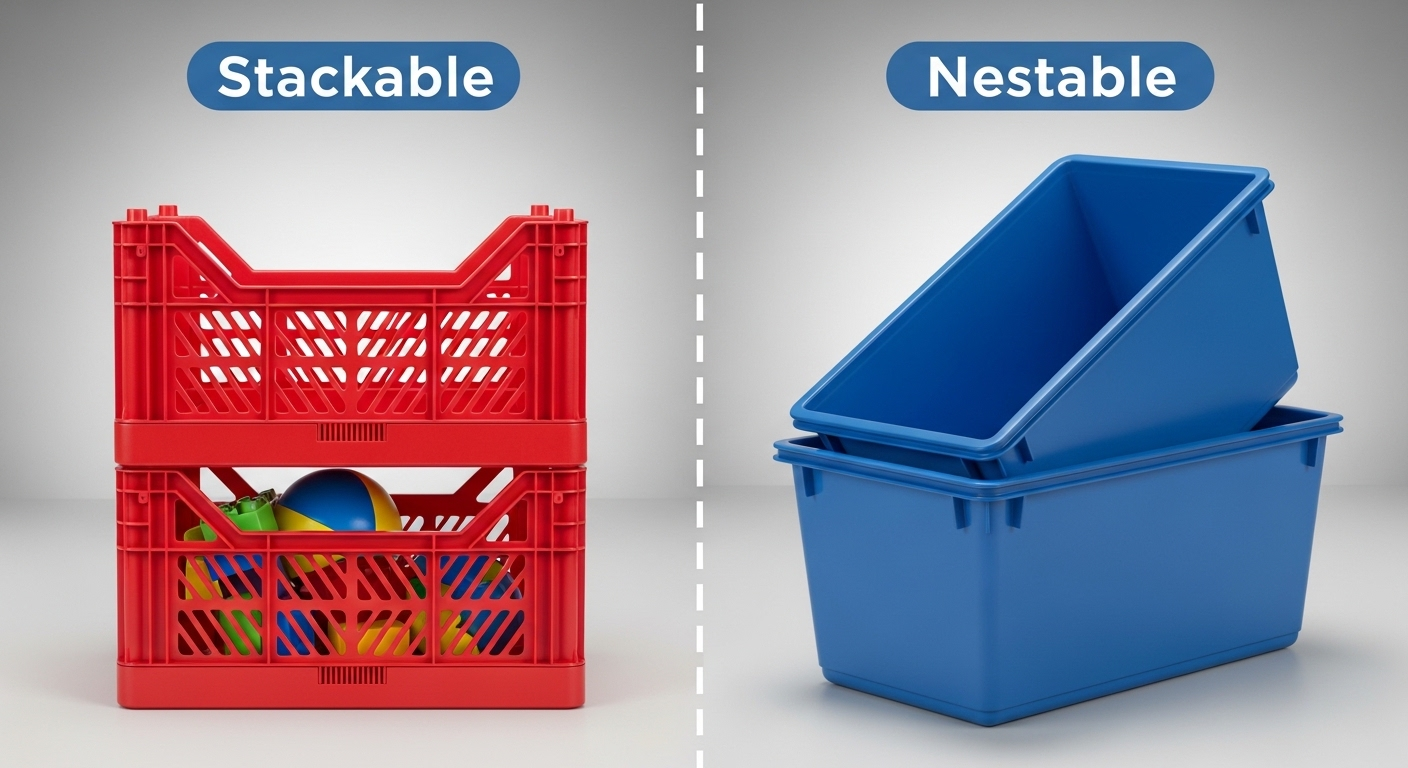
Selecting the right crate design can directly impact storage efficiency, transport safety, and operational costs. Businesses handling goods across warehouses and distribution networks often compare stackable and nestable options before making a decision.
Both designs offer unique advantages depending on how products are stored and moved. Understanding their differences helps you invest in the most practical solution for your supply chain.
- Understanding Stackable Crates
- Understanding Nestable Crates
- Comparing Storage Efficiency
- Impact on Transport Safety
- Cost Considerations
- Industry Specific Applications
- Durability and Material Strength
- Space Optimization Strategy
- Environmental and Operational Benefits
- How to Make the Right Choice
- FAQs about Stackable vs Nestable Plastic
- Conclusion
Understanding Stackable Crates
Stackable crates are designed to sit securely on top of one another when filled. Their reinforced base and lid support vertical loads without collapsing.
This design maximizes vertical storage space in warehouses, trucks, and cold storage facilities. It also keeps goods organized and stable during transport.
Key Benefits of Stackable Designs
- Strong load-bearing capacity
- Stable vertical stacking
- Reduced risk of crushing
- Ideal for heavy or fragile goods
- Efficient use of warehouse height
Industries such as manufacturing, retail distribution, and agriculture commonly use stackable plastic crates to protect products while optimizing floor space.
Understanding Nestable Crates
Nestable crates are engineered to fit inside one another when empty. This reduces the space they occupy during return transport or storage.
When not in use, businesses can stack them in a nested form, cutting down storage volume significantly. This makes them a preferred choice for operations that frequently move empty crates back to suppliers.
Key Benefits of Nestable Designs
- Space-saving when empty
- Lower reverse logistics costs
- Lightweight handling
- Suitable for short-term storage
- Efficient for high volume turnover
Nestable storage containers are widely used in food distribution, retail supply chains, and delivery networks where empty crate management is important.
Comparing Storage Efficiency
If vertical storage of loaded goods is the priority, stackable crates provide better support. They allow businesses to safely build upward without compromising product safety.
On the other hand, if your operation involves returning empty crates regularly, nestable models reduce storage footprint and transport expenses.
The decision depends on whether your focus is on maximizing filled storage space or minimizing empty return space.
Impact on Transport Safety
Transport stability is essential to prevent product damage. Stackable crates maintain firm alignment during transit, reducing movement inside delivery vehicles.
Nestable crates also offer durability when filled, but their primary advantage lies in reverse logistics rather than heavy load stacking.
Businesses transporting fragile or high-value items often prefer stackable industrial crates for added security.
Cost Considerations
Initial investment for both types is comparable, depending on size and material quality. However, long-term costs vary based on usage patterns.
If your supply chain involves frequent returns of empty containers, nestable crates lower transport costs. If vertical stacking of goods is critical, stackable designs provide better value over time.
Careful evaluation of your logistics flow ensures better cost efficiency.
Industry Specific Applications
Agriculture and fresh produce sectors often use ventilated stackable crates for airflow and stability.
Retail chains and supermarkets may prefer nestable containers to manage empty returns efficiently.
Manufacturing facilities handling heavy components typically select reinforced stackable storage crates to prevent compression damage.
Understanding your industry’s operational requirements helps determine the right fit.
Durability and Material Strength
Both stackable and nestable crates are manufactured using high-quality plastic materials. They resist moisture, corrosion, and repeated handling stress.
Reusable plastic storage solutions provide long service life compared to disposable packaging. This durability makes them suitable for demanding environments.
Crateco Pack LLC offers plastic crate systems designed for strength and reliability across industries in the UAE. Their product range includes different sizes and configurations to match specific storage and transport needs.
Space Optimization Strategy
Space optimization plays a crucial role in warehouse management. Stackable crates allow businesses to utilize vertical warehouse capacity effectively.
Nestable crates help minimize idle storage space when containers are empty. Companies operating with limited storage areas often evaluate this factor carefully.
Choosing the right system supports smoother operations and better inventory control.
Environmental and Operational Benefits
Reusable crate systems reduce packaging waste and support sustainable logistics models. Their long lifespan lowers the need for disposable materials.
By investing in durable plastic storage crates, businesses improve efficiency while reducing environmental impact.
Reliable crate solutions from Crateco Pack LLC help organizations achieve both operational and sustainability goals without compromising product protection.
How to Make the Right Choice
When selecting between stackable and nestable designs, evaluate your operational priorities carefully. Consider whether your business requires strong vertical stacking to support loaded goods during storage and transport.
Assess how frequently empty crates are returned within your supply chain, as this directly affects space and transport efficiency. Product type also plays an important role, since heavier or fragile items may demand greater load stability.
Warehouse space availability and your long-term logistics strategy should also guide the decision. Reviewing these factors helps determine which crate design best supports your operational goals.
FAQs about Stackable vs Nestable Plastic
1. What is the main difference between stackable and nestable crates?
Stackable crates are designed to hold weight when stacked with goods inside, while nestable crates fit into each other when empty to save space.
2. Are stackable crates stronger than nestable ones?
Both are durable, but stackable crates are specifically engineered to support heavier vertical loads during storage and transport.
3. Which crate type is better for retail supply chains?
Retail operations that frequently return empty containers often prefer nestable crates for space-saving benefits.
4. Can both types be used for food storage?
Yes, many designs include ventilated and hygienic features suitable for food handling and cold storage.
5. Where can I find reliable crate suppliers in the UAE?
Crateco Pack LLC offers a wide range of durable crate solutions tailored for various industries across the UAE.
Conclusion
Both stackable and nestable crate systems offer valuable benefits. The right choice depends on your storage patterns, transport frequency, and product type.
If your priority is stable vertical storage and heavy load protection, stackable options are ideal. If minimizing empty storage space is critical, nestable crates provide a practical advantage.
With high-quality solutions from Crateco Pack LLC, businesses in the UAE can select durable and efficient crate systems that enhance logistics performance and safeguard products at every stage of the supply chain.
